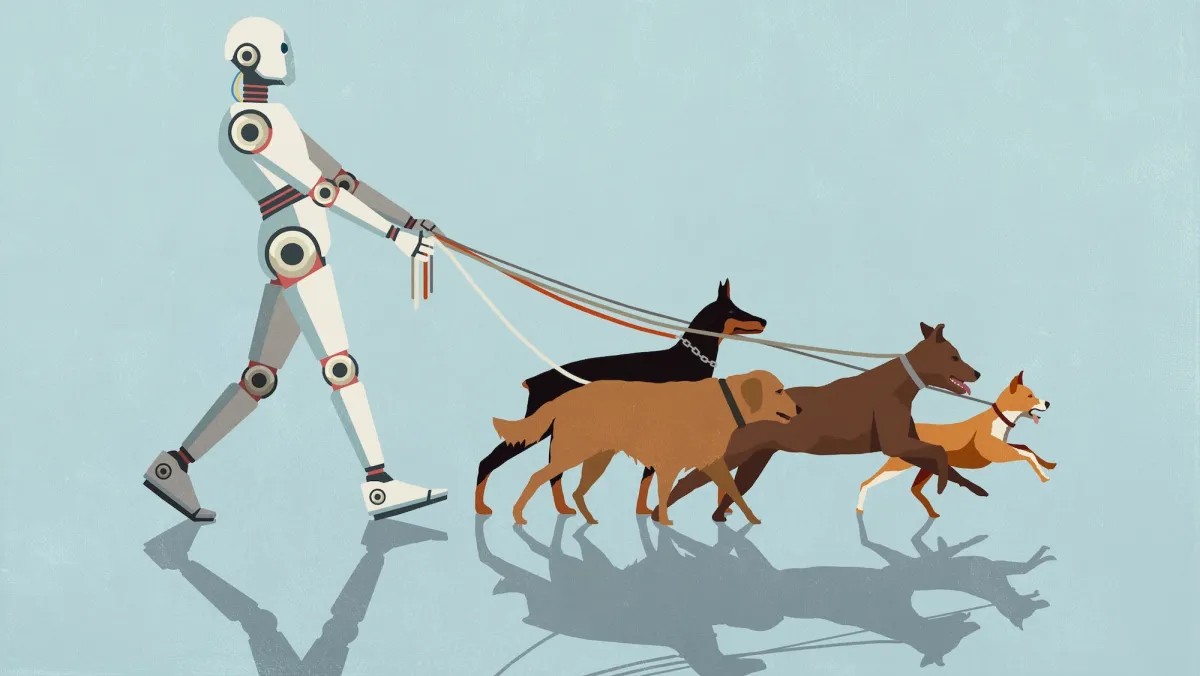
For decades, science fiction has obsessed over a single vision of the future: the humanoid robot. From Pinocchio to Spielberg’s A.I., the narrative is consistent—if we build something that looks, moves, and acts like a human, we will eventually create something indistinguishable from us.
However, in the cutting-edge labs of modern robotics, a different, stranger reality is unfolding. Instead of striving for a perfect human replica, engineers are realizing that mimicking the human form may actually be a handicap.
The Trap of Biomimicry
There is a fundamental difference between borrowing a principle from nature and copying its shape. Engineers have long successfully used “biomimicry” to solve problems: gecko-inspired adhesives and sharkskin-textured swimsuits are triumphs of physics. But when it comes to movement, wholesale imitation often fails.
For centuries, inventors tried to build “ornithopters”—machines that flap wings like birds—only to realize they were a dead end for flight. The Wright brothers succeeded not by flapping, but by mastering the underlying principles of lift and control.
The same logic applies to robotics. A human body is designed for survival through muscles, tendons, and chemical energy. A robot, however, operates on metal, motors, and electricity.
“Studying natural organisms gives us a sense of the level of performance that can be reached… It serves as a useful reference, but it is more appropriate to use it as a source of ideas rather than replicating it directly.” — Prof. Park Hae-won, KAIST
Form Follows Function: Solving Real-World Problems
At the Hubo Lab at KAIST, led by Prof. Park Hae-won, the goal isn’t to make a robot that looks like a person, but a machine that solves a specific task. This “problem-first” approach has led to several radical departures from the human silhouette:
- Speed over Symmetry: While humans must transition into a run to move quickly, KAIST’s two-legged robots can sprint at 12.6 km/h using movements that more closely resemble a “moonwalk” than a human stride.
- Extreme Environments: The MARVEL quadruped robot was designed for hazardous industrial sites like shipyards and bridges. Instead of using gecko-inspired pads—which would fail on rusted, greasy steel—engineers equipped MARVEL with electro-permanent magnets. These allow the robot to “lock” onto vertical walls and ceilings with a five-millisecond pulse, carrying its own weight plus heavy tools.
- The Single-Leg Challenge: In a bold move to test balance, the team built a robot consisting of only one leg. By mastering the brutal physics of a single-legged hopper that can perform mid-air somersaults, the researchers proved their algorithms could handle even the most extreme stability challenges.
The “Sim-to-Real” Gap: Where Software Meets Hardware
Even with perfect designs, a major hurdle remains: the gap between simulation and reality.
Modern robots use Reinforcement Learning (AI) to learn how to move. Because training a physical robot via trial and error would take years, researchers use high-performance computers to run thousands of simulations simultaneously. In the virtual world, a robot can “practice” for a year in just four hours.
The problem is that simulations are often “too perfect.” They frequently fail to account for real-world friction and the mechanical limitations of motors. A robot that learns to walk in a frictionless digital world will promptly topple over on a real factory floor.
To bridge this gap, the KAIST team uses two strategies:
1. Hardware Alignment: They developed “quasi-direct drive” actuators with lower gear ratios to reduce internal friction, making the physical robot behave more like its smooth-moving digital twin.
2. Data-Driven Simulation: Instead of using simplified math, they feed the actual, messy performance curves of their custom motors into the AI, ensuring the software knows exactly where the hardware’s limits lie.
The Economic Reality of Robotics
The hype surrounding humanoid robots is massive, but history is littered with expensive failures, such as Honda’s ASIMO. For a robot to move from a laboratory demonstration to a commercial success, it must solve a labor problem.
In South Korea, a rapidly aging population is creating a vacuum in the manufacturing sector. Young workers are moving away from manual labor, leaving a gap that older workers and foreign laborers cannot fully fill.
Prof. Park’s focus is on utility over aesthetics. His robots are being built to carry payloads of 25kg or more—far exceeding most current humanoids—specifically to handle the heavy-duty tasks of a modern factory floor.
Conclusion
The future of robotics lies not in creating digital humans, but in designing specialized machines that leverage the unique strengths of electricity and metal. By prioritizing functional efficiency over biological imitation, engineers are moving closer to robots that truly complement and enrich human work.