Stress triggers it.
When antibiotics hit a microbe, the neighbors panic. But not in a way we expected. They don’t just hunker down. They reach out. They share proteins.
It sounds wild, I know. We have always known bacteria trade DNA. Horizontal gene transfer is a staple of microbiology. We know they pass around resistance genes like party favors. But scientists have long suspected a darker, more complex layer. Maybe they trade functional proteins, too. Tiny fluid bubbles called vesicles were thought to be the delivery trucks. Fatty membranes, protein cargo, zip zip gone.
But the proof?
It wasn’t there.
“[If you look back], there was no evidence,” says Christophe. Herman, a Baylor College of Medicine microbiologist. Until now. He and his team just published a paper in Science that finally catches the act. Live. On tape, so to speak.
The trap
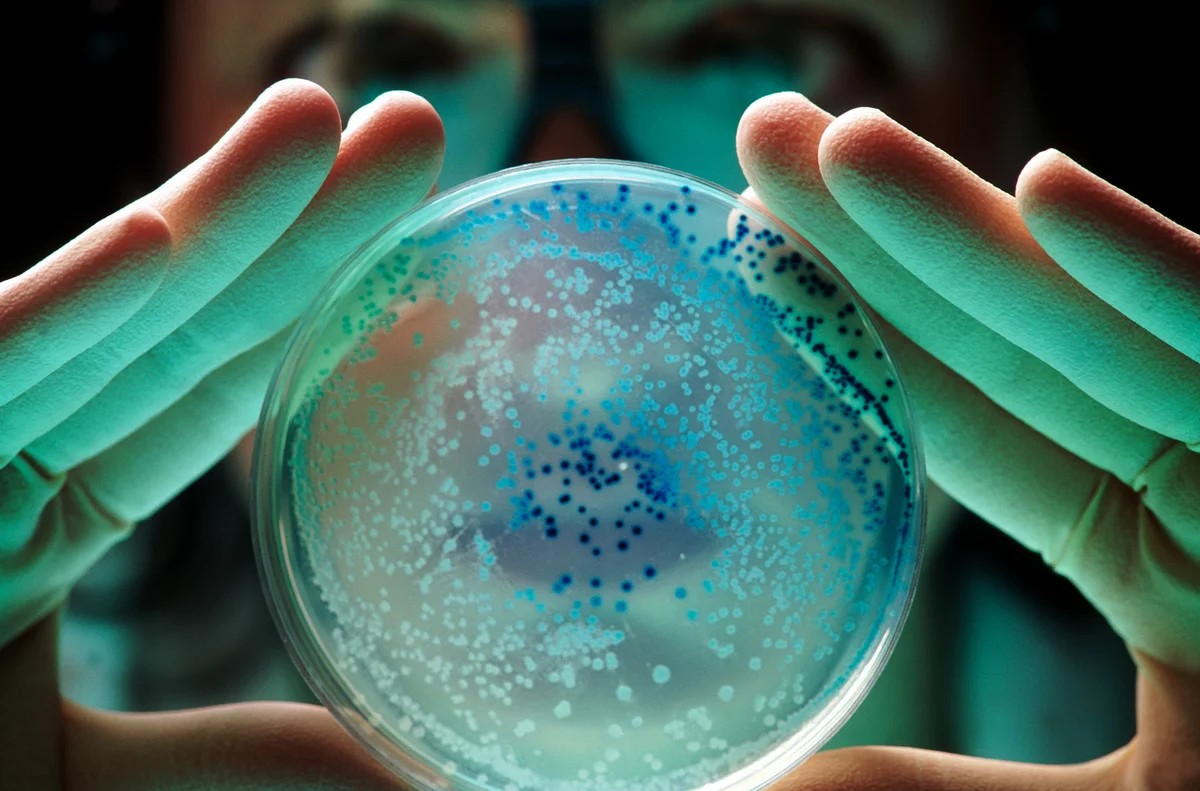
Herman and his colleagues set a trap. Simple. Elegant. They used two populations of E. coli.
First, the recipients. These poor bastards carried a broken gene. Inverted, useless, silent. Without a functional version of this specific gene, they could not process galactose, a simple sugar. They were essentially starving for that specific energy source.
Then the donors. These guys had a weapon: Cre recombinase. A protein that can fix inverted genes. It acts like a pair of scissors and tape. It cuts and pastes the gene back into working order. If a recipient cell received this Cre protein, it could flip the gene back on. Feast mode enabled.
Here is the catch. DNA transfer would not do the trick here. The recipients needed the actual protein to fix the immediate problem. They had to physically receive the Cre recombinase from a donor.
The experiment seemed destined for failure. Or boredom.
“[Herman] went on vacation. I was in the lab. I don’t think we expected anything,” recalls lead author Alice Wen.
They watched the petri dishes. Days passed. And then. Slowly, painstakingly, the signal appeared. The bacteria did share. The Cre protein moved. The recipients ate the galactose. The trade happened.
It was agonizingly slow though. A trickle, not a flood.
Until the pressure mounted.
The antibiotic effect
Throw antibiotics at the mix.
Watch the reaction.
The transfer rate skyrocketed. By a factor of four thousand. That is not a fluctuation. That is a panic response. The stress of the drug forces the community into a frantic exchange of resources.
In the wild, this splits bacteria into two tribes. The martyrs and the dormant.
Most cells react by shedding vesicles. They unload protein cargo into the environment, leaving themselves exposed. It’s a suicide pact of sorts, but the cargo lands on the neighbors. Meanwhile, other cells go quiet. They stop reproducing. They shut down protein production to hide from the drug. They are dormant, fragile, and in need of help.
Herman thinks the vesicles deliver repair tools. DNA polymerases. Stuff these dormant cells need to restart life once the bombardment stops. The living feed the sleeping. It works even across species boundaries.
Why?
Who knows. We really don’t know.
“We just know it happens,” says Wen.
Maybe it’s population survival. One cell dies so the others live. Or maybe it is selfish in a subtle way. Perhaps a cell grabs a neighbor’s protein to test-drive it. A microbial free trial. Before it commits to stealing the permanent goods, like DNA, it tries on the neighbor’s skills first.
It works. That’s the thing.
Laurence Van Melderen from Université Libre de Bruxelles was not involved in the research. She watched from the outside. She likes what she sees.
“This is a very elegant way to prove protein transfer exists. I’m confident they are right,” she says.
The controls were strict. No loopholes. The conclusion holds. Bacteria share their hardware when things get bad. They pass the torch. They share the load.
We usually think of survival of the fittest as a solitary sport. The loner. The strongest. But here, at the microscopic level, the community matters more than the individual. They build a safety net made of fat and protein.
It leaves us wondering who the real enemy is.