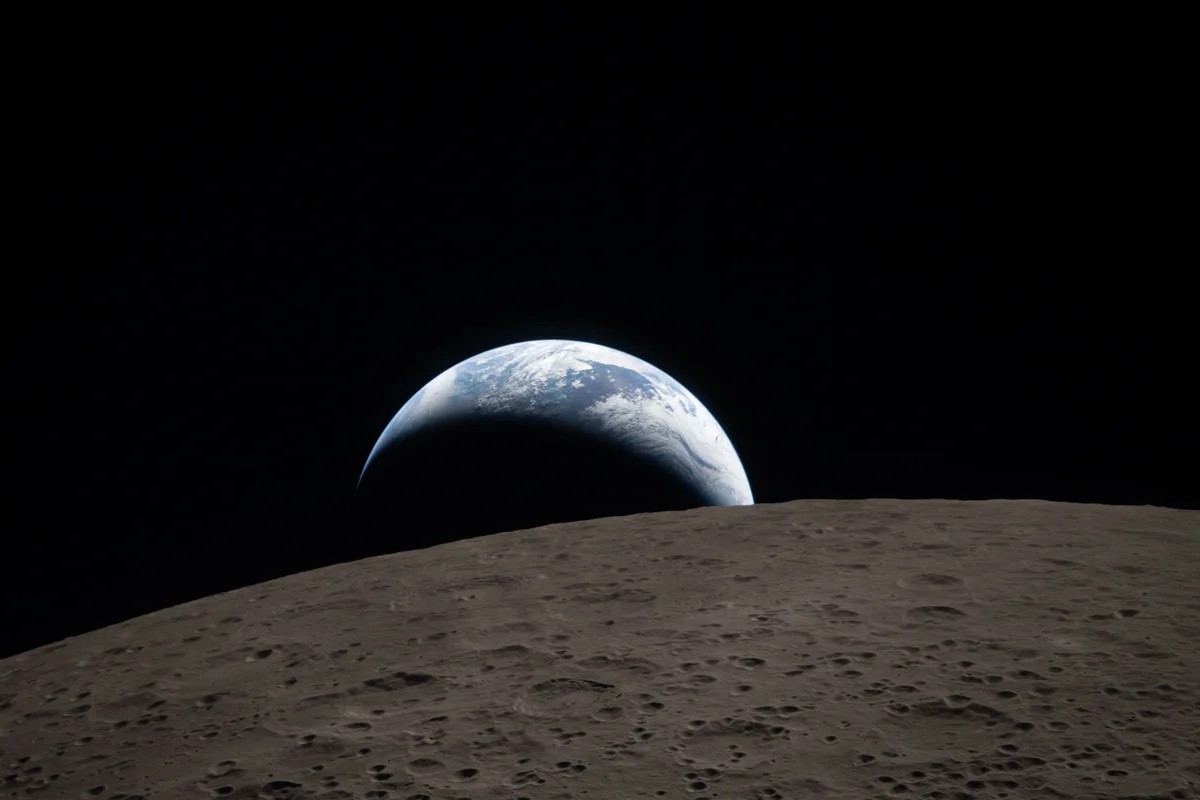
The recent conclusion of NASA’s Artemis II mission has provided more than just scientific data; it has delivered a profound visual moment. As the crew traveled around the Moon, they captured a striking image of Earth—a vibrant blue crescent suspended above a desolate, cratered lunar landscape.
While the image feels strikingly familiar, it serves as a modern echo of one of the most influential photographs in human history: the 1968 “Earthrise” shot from the Apollo 8 mission. As we enter a new era of lunar exploration, a critical question emerges: Can these new perspectives reignite the global environmental movement that the Apollo era once inspired?
The Legacy of the Apollo Era
In 1968, the world was a different place. Human spaceflight was in its infancy, and no one had ever seen the Earth from beyond low Earth orbit. When the Apollo 8 astronauts looked back at our home planet, the experience was transformative.
Historians note that this wasn’t just a scientific milestone; it was a spiritual one. The images captured during the Apollo missions—most notably “Earthrise” and the 1972 “Blue Marble”—did something unprecedented:
– They provided scale: Humanity saw the Earth not as an infinite expanse, but as a solitary, fragile sphere.
– They fueled activism: These images became the visual backbone of the first Earth Day in 1970, helping to transform environmentalism from a niche concern into a mainstream global movement.
– They bridged science and symbolism: NASA’s ability to pair high-resolution imagery with data on ozone depletion and pollution turned space photography into a powerful tool for environmental advocacy.
The Artemis Shift: From “Rise” to “Set”
The Artemis II mission marks the first time humans have left Earth’s orbit since 1972. However, the context of this journey is vastly different. While the Apollo era dealt with visible pollution and conservation, the Artemis era is defined by the existential, often politicized struggle against climate change.
The new imagery released by NASA has been aptly, if perhaps unintentionally, dubbed “Earthset.” This term reflects the mission’s trajectory, but historians suggest it also serves as a metaphor for our current cultural moment.
“It perfectly captures this cultural moment where we’re facing the most important global crisis in human history… and the Earth is imperiled because of that.” — Neil Maher, Environmental Historian
A New Sense of the “Sublime”
For modern astronauts, the view remains as jarring as it was for their predecessors. NASA astronaut Christina Koch described the Earth as a “lifeboat” hanging undisturbed in a vast, black void. This sense of “the sublime”—a mixture of awe and terror—is a psychological phenomenon that has historically driven humans to protect the natural world.
However, the Artemis program faces unique challenges that the Apollo era did not:
1. Political Polarization: Unlike the “common sense” environmentalism of the 1970s, climate science today is deeply divided by political lines.
2. Funding Uncertainties: NASA’s science division faces significant budgetary pressures, with proposed cuts that could impact the agency’s ability to conduct deep-space research.
3. Visual Fatigue: In an age of saturated media, the “shock value” of space imagery may be harder to achieve.
Conclusion
While the Apollo images helped launch the modern environmental movement, the Artemis mission arrives at a time when the Earth is more vulnerable than ever. Whether these new images can break through modern political apathy to inspire a new era of planetary stewardship remains to be seen, but they have already succeeded in reminding us of a fundamental truth: our world is a solitary, fragile oasis in the dark.