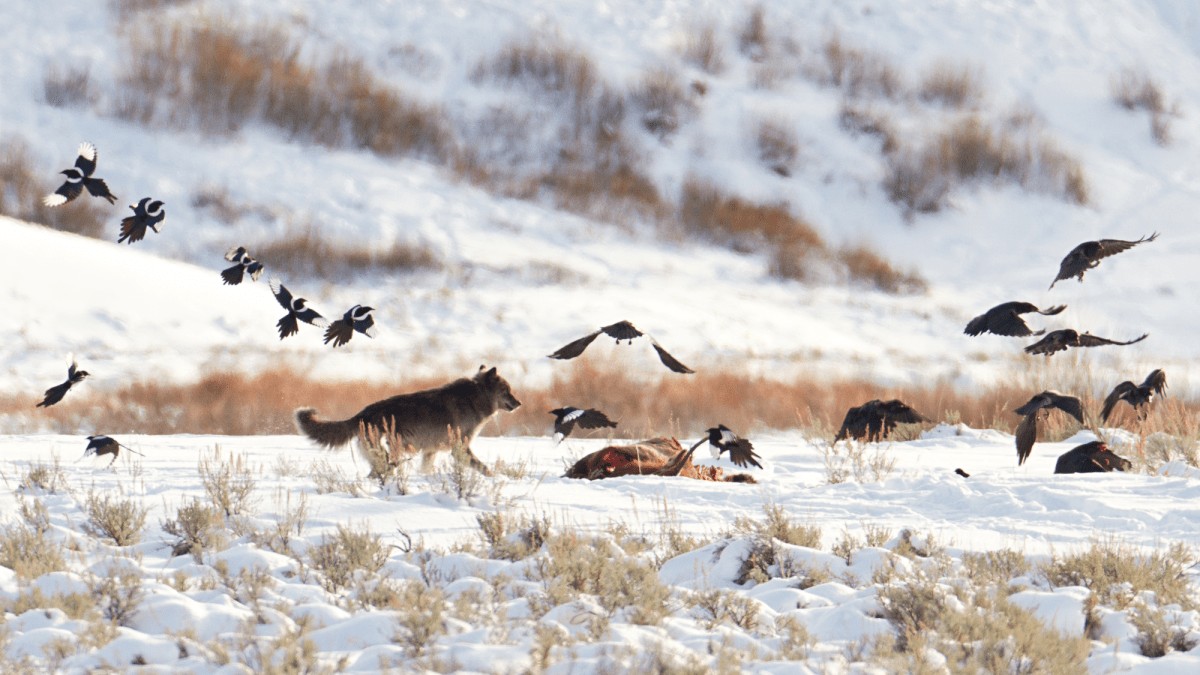
Ravens in Yellowstone National Park don’t just follow wolves – they remember where hunts happen, actively seeking out scavenging opportunities based on past kills. A new study published in Science confirms these birds aren’t merely opportunistic; they demonstrate a calculated, learned behavior that leverages the predatory success of another species. This finding highlights not just avian intelligence, but also the complex, often overlooked relationships between predator, prey, and scavenger communities in the wild.
Tracking the Connection
For two and a half years, researchers tracked 70 ravens (Corvus corax ) and 20 gray wolves (Canis lupus ) in northern Yellowstone. Using GPS backpacks on ravens and tracking collars on wolves, they monitored movement patterns around confirmed kill sites. The data revealed a striking trend: ravens consistently appeared at carcasses within seven days of a wolf hunt, even traveling up to 93 miles (150 kilometers) to reach them.
This isn’t simply about chance. Ravens possess exceptional spatial memory and learning capabilities, suggesting they are actively recalling locations where successful hunts occur. Wolves, rebounding after near-eradication due to conservation efforts over the past three decades, concentrate their hunting in specific areas of Yellowstone, creating predictable “hotspots” for scavenging.
Beyond Opportunism: A Calculated Strategy
The study’s findings challenge the traditional view of ravens as passive scavengers. Instead, they demonstrate a level of foresight: the birds are planning where to search, effectively exploiting the hunting patterns of wolves. As Matthias-Claudio Loretto, a co-author on the study, explains, “They’re not just opportunists—they’re planning where to search.”
“Animals don’t just navigate landscapes—they navigate communities of other species.” – Matthias-Claudio Loretto
This behavior echoes patterns observed in other species. Blue whales track phytoplankton blooms, while chimpanzees revisit productive fruit trees. The Yellowstone ravens represent another example of how animals actively monitor and exploit the activities of other species within their ecosystem.
Implications and Future Research
The study raises broader questions about animal perception and interspecies awareness. How early in life do ravens learn these scavenging patterns? Is this skill innate, or honed through years of experience? Researchers plan to investigate these questions further, delving into the developmental stages of this learned behavior. Understanding these interactions is crucial, as it underscores the intricate web of connections that shape ecological dynamics – a reminder that nature is rarely as simple as predator versus prey.
The findings emphasize that animal behavior is often far more nuanced than previously assumed, and that seemingly “lower” species may exhibit cognitive abilities previously reserved for higher-order animals.