Algebraic expressions are essentially mathematical shorthand. They combine numbers, letters, symbols, and arithmetic operators to represent complex relationships in a simplified format. Without them, explaining certain formulas would be unnecessarily difficult and prone to misinterpretation.
Think of an algebraic expression as a way to establish equalities without getting bogged down in specific values. It allows you to describe a relationship between elements quickly and clearly. This simplicity is why they are so fundamental to mathematics.
For students and lifelong learners, understanding these expressions is key to mastering more advanced topics. They serve as the building blocks for solving equations and understanding patterns in data. Whether you are a parent helping with homework or an adult returning to education, grasping this concept is practical and essential.
The power of algebraic expressions lies in their ability to generalize. Instead of dealing with a single number, you handle a variable that can change. This flexibility makes problem-solving more efficient and scalable. It is a tool that simplifies communication and enhances understanding across various fields.
In the next part, we will explore how to manipulate these expressions to solve real-world problems. Stay tuned for practical examples and step-by-step guidance.
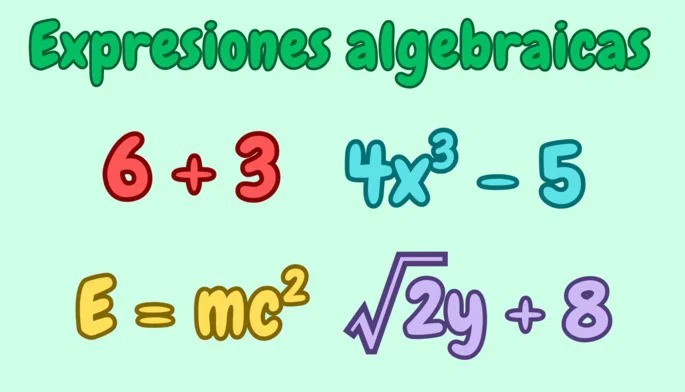
You don’t need a math degree to understand why shorthand is useful. Take 6 + 3. Simple. But what if you have 2x + √y - 7 = z² + z/4? It takes a few seconds to say this out loud. Writing takes a few milliseconds.
We often use these formulas. grocery shopping. Engineering. Science problems. They let us figure out operations quickly.
The speed of symbols
Consider the following equation.
2x + √ y – 7 = z2 + z/4
Try reading it out loud. “X times two plus the square root of y minus seven equals z squared plus z divided by four.”
Do you see the difference? These symbols do the heavy lifting for you. Communication is faster. Your understanding will become clearer.
That’s why we bother to use algebraic notation.
- Create an easy-to-read language for complex math.
- Solve problems that require precise terminology.
- Map relationships between elements easily.
- Build equations and functions using one or more variables.
Breaking down the components
To really understand it, you have to know what you’re looking at. An expression is more than just a random string. It has structure.
Terms
The building blocks are terms. These are parts separated by plus or minus signs. 3x + 5 has two terms: 3x and 5.
Coefficients
If a numerical value is added to the term variable, this numerical value becomes a multiplier. In 3x, 3 is the multiplier. It tells you how many variables there are.
Variable
These are letters. x, y, z. They represent unknown numbers or variable values. These are placeholders for the actual data.
Constants
These are independent figures. Same as 5 in the example above. they haven’t changed. These are fixed values.
Exponents
Let’s take a look at the z². That little 2 is an exponent. It tells you to multiply z by itself. Indicates how many times the position has been used as a factor.
Radical
The symbol √ in the previous example is a radical. It indicates a root. Square root, cube root, whatever. It’s the inverse of exponentiation.
Practical application
Why is knowing these parts useful? Because you can manipulate the expression. x cannot be solved without knowing which parts are variables and which are coefficients.
Take ax + b = c.
・a is a multiplier of x.
– x is a variable.
– b is a constant.
– c is the result.
Swapping b and c changes the whole meaning. Precision matters.
When to use them
We don’t use complex polynomials to buy coffee. But you use the logic behind them.
Use a linear equation to calculate the total cost of a product including taxes.
When determining the trajectory of a thrown ball, we use a quadratic equation.
When you adjust a recipe for two servings, you use proportions.
Algebra is more than just a random collection of symbols. This is language. Like any other language, it has grammar, vocabulary and structure. If you want to know why you need to learn these things, start by looking at the building blocks. Every algebraic expression consists of certain components. Numbers. Letters. Operators. Once you understand what each piece does, math stops feeling like a puzzle and starts feeling more like a map.
Parts of Algebra
Let’s break it down a bit. You can’t build a house without understanding bricks and mortar. In algebra, the building blocks are numbers and variables. Mortar is the grammar that holds everything together.
Number
A number is a specific amount. These are things that can actually be counted and measured. In expressions, these appear in two main ways. They appear as independent terms (which just sit there and do their own thing) or as coefficients (which multiply the variables).
Consider the number 5. This is only 5. But for 5x, this is a multiplier. You are asked to multiply x by five. The number can be a whole number such as 1, 5, 10 or 843. You can also specify a decimal number such as 11.6374. They provide a constant value in uncharted waters.
Letters (Variables and Constants)
This is where it gets interesting. Letters usually represent variables or unknown quantities that can be changed. The most common are x, y and z. These are placeholders for the values you are trying to find or describe.
However, not all characters are variables. Some are constant. These are certain immutable values that the characters represent.
* π (pi)
e (Euler’s number)
* G (universal gravitational constant)
When you see these characters, don’t think they are unknown. they are fixed. you can trust them. What about the rest of the alphabet? It’s fair game for variables.
Terms
A term is a unit. It can also be a number. It can also be a variable. Or maybe a combination of both. In 3x^2, 3x^2 is one term. In 3x^2 + 5x, you have two terms. How do you tell the difference? addition and subtraction. If there is a plus or minus sign between two sets of symbols, you have reached a term boundary.
Symbols and operators
The operator tells you what to do. Addition, subtraction, multiplication and division. It’s simple enough. But algebra doesn’t just use basic four. You will encounter something like this:
* Equality : =
* Inequalities : > (greater than), < (less than)
* Root : √ (square root)
* Percentage : %
* Summation : ∑
Next we have the grouping symbols: parentheses (), brackets [] and braces {}. These are very important. Defines the sequence of operations. These tell your brain (and your calculator) which part of the mess to solve first. Without these, the 2 + 3 * 4 would be ambiguous. (2 + 3) * 4 is now clear.
And don't forget the signs. The positive sign + and the negative sign - represent the direction on the number line. they changed everything.
Read the language
Writing algebra is easier than speaking it. This is a common complaint among students. You could easily write 2x + 6, but saying "2x plus 6" feels awkward compared to shorthand. Let's see how to translate these expressions from math to English.
| Algebraic expression | How to read |
|---|---|
| 2x + 6 | The double of a number, plus six. |
| x² + x/2 | The square of a number plus half of it. |
| x/3 - √5 | One third of the number minus the square root of 5. |
| (3 x 5) + (8 x 2) | 3 x 5 and 8 x 2 sum. |
| x3 + 4x2 - 6x + 3 = 0 | The cube of a number plus four times its square, minus six times this number plus three, is zero. |
| x + y = 15 - z² | The sum of two different numbers is equal to 15 minus the square of the third number. |
| (³√x + 4y) / y³ | The cube root of one number plus 4 times the second number divided by the cube of the second number. |
| (x) + (x+1) + (x+2) + (x+3) | Sum of four consecutive numbers. |
| xy + x² - y/4 = 12 + √z | The product of two numbers, the square of the first number minus a quarter of the second number, is equal to 12 plus the square root of the third number. |
Do you see a pattern? Algebra compresses complex verbal descriptions into compact and efficient notations. This is more than just an shorthand. It's accuracy.
Classifying Expressions: monomials and polynomials
Once you know how to read an expression, you need to classify it. In general, algebraic expressions are divided into two main categories based on their structure: monomials and polynomials.
Monomial expression
Monomials are simple. one term. that's it. There is no addition or subtraction. Only one unit.
A monomial expression looks like this:
5 (number only)
x (variable only)
* 3y² (coefficient, variable, exponent)
If you can count the terms and get one, it's a monomial.
Multinomials
Multinomialss are more complicated. These contain two or more terms separated by addition or subtraction.
Within polynomials there are subtypes based on the number of terms.
* binomial : two terms (eg x + 5 )
* Trinomial : 3 terms (eg x² + 2x + 1 )
* Multinomials : More than three terms.
Multinomialss are also classified by degree. The degree is determined by the largest exponent of the expression. The polynomial in x³ is a third-degree polynomial. The polynomial in x⁵ is a fifth-degree polynomial. The higher the degree, the more complex the curve the equation follows in the graph.
Beyond the Basics: equations and functions
Monomials and polynomials cover many things, but they are not everything. Algebraic expressions change label based on their behavior.
Equation (equation)
When you add an equals sign = makes it more than just a value description. You tell the relationship. You’re saying one thing is another thing.
x + 5 = 10 is an equation.
x + 5 is just an expression.
Equations are problem solving tools. You can isolate variables and find variables.