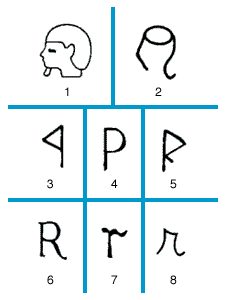
The letter R is not just a random shape. It is the eighteenth letter in the modern Latin alphabet, but its history goes back much further. It has its roots in the ancient Semitic letter resh. Some linguists believe it even evolved from an early hieroglyph that looked like a head. If you look at the classical Greek Rho, you see a form that remained almost unchanged in the early writings on the island of Thera. The same form is found in early Attica and Corinth. It also appears in the Chalcidian alphabet.
How the shape developed
Most Greek versions of the letter looked like a rounded P. This was the standard form of the Lydian alphabet. But when the letter moved to the Mediterranean, things began to change. In both the eastern and western regions, a version appeared in which the loop extended to the lower part of the vertical stroke. This particular form occurs in the Italian Umbrian and Oscan alphabets. The Etruscans used a version where the loop extended almost all the way down.
This is where the Latin version gets its special look. A form appeared in the Chalcidian alphabet that added a oblique stroke. This must be the ultimate source of the Latin r we know today. In the Latin version this extra stroke is exaggerated. It is a direct descendant of this ancient Greek variation.
From ancient stone to modern screen
The diminutive form of R has undergone many variations over the centuries. In the 6th century CE, cursive Latin showed in which the loop was lost. It is shortened to a single curved stroke. The Irish alphabet followed a similar path in the seventh century. There, the remains of the loop and oblique stroke stretched horizontally.
Based on this Irish influence, the Carolingian r. In this version, the vertical line did not extend below the line. This Carolingian form is the minuscule r used in modern printing. But the handwriting tells a different story. The printed version still struggles with a form that resembles the old Latin cursive tradition. Both exist side by side today, depending on whether you typing or sign your name.
How sound changes everything
The letter itself is only half the story. The sound represented by R varies greatly. To make a sound, you usually place the tip of your tongue on the roof of your mouth and pronounce it. But the exact quality changes. It varies from language to language. It even changes depending on where the letter is in the word.
The trilled “r” is one of the most well-known variations. You create it by vibrating the tip of your tongue against the ridge of bone behind the upper teeth. This sound occurs in several continental languages. You’ll also hear it in certain dialects of English. Then there is a back or uvular R. This is typical of the French language. It is also current in many parts of Germany. Your tongue does not touch the roof of your mouth here. The vibration occurs further in the throat.
In southern England and the eastern United States, the r is often softer. In many cases it is pronounced softly. Sometimes it is omitted altogether when it occurs at the end of a word. This drop-out effect is common in these particular dialects.
What about spelling? You may notice words like rhetoric that begin with rh. This spelling is practically limited to words of Greek origin. It represents the classical Greek spelling of the word Rho with a rough breathing mark. In ancient times, this sign indicated unsoundd pronunciation. For historical reasons, we keep the spelling the same, even if the sound has changed.
Is the letter r more important as a shape or as a sound? It changes according to each region. It changes with the century. The story is written in ink and stone, but the sound is alive in every conversation. It hangs in the air vibrating or silently depending on where you stand.