It started in late February.
Since then the Middle East has taken a pounding, the Persian Gulf right in the crosshairs. Mines are everywhere in the Strait of Hormuz. Oil leaks. Missiles miss the nuclear plant but get close enough to scare anyone who understands radiation seepage.
But the war isn’t just blowing up infrastructure.
It’s threatening a biological library we didn’t know we were losing.
Before this current chaos scientists already said the Gulf was hanging by a thread. Now? They fear those threadbare ecosystems will snap. Evolution in action. Genetic blueprints for surviving climate hell. All going up in smoke or oil slicks.
“These environments are on the edge” Kaveh Samimi-Nemin says. He’s a marine biologist who grew up in Iran but now works at the Naturalis Biodiversity Center. “Anything that impacts the environment can really push that biodiversity off the cliff.”
A young sea. A hard sea.
The Persian Gulf is a weird place.
Bernhard Riegl of Nova Southeastern University has studied it for thirty years. He calls the geography remarkable. Sandwiched between Iran and Arabia the water is young. Six thousand years young. It only filled after the last ice age melted away.
Everything living in there is a recent arrival. The corals haven’t had time to build massive reefs.
The water itself is brutal. Summers roast you. Winters bite. And it is incredibly salty. Most people think it’s a desert underwater. They’re wrong.
Mohammad Reza Shokri of Shahid Beheshti University disagrees with the “biologically poor” label. It’s not poor. It’s just tough.
Think about it. Drop a coral from the Great Barrier Reef into the Gulf?
“Toasted.” Samimi-Nemin says they’ll be toasted immediately.
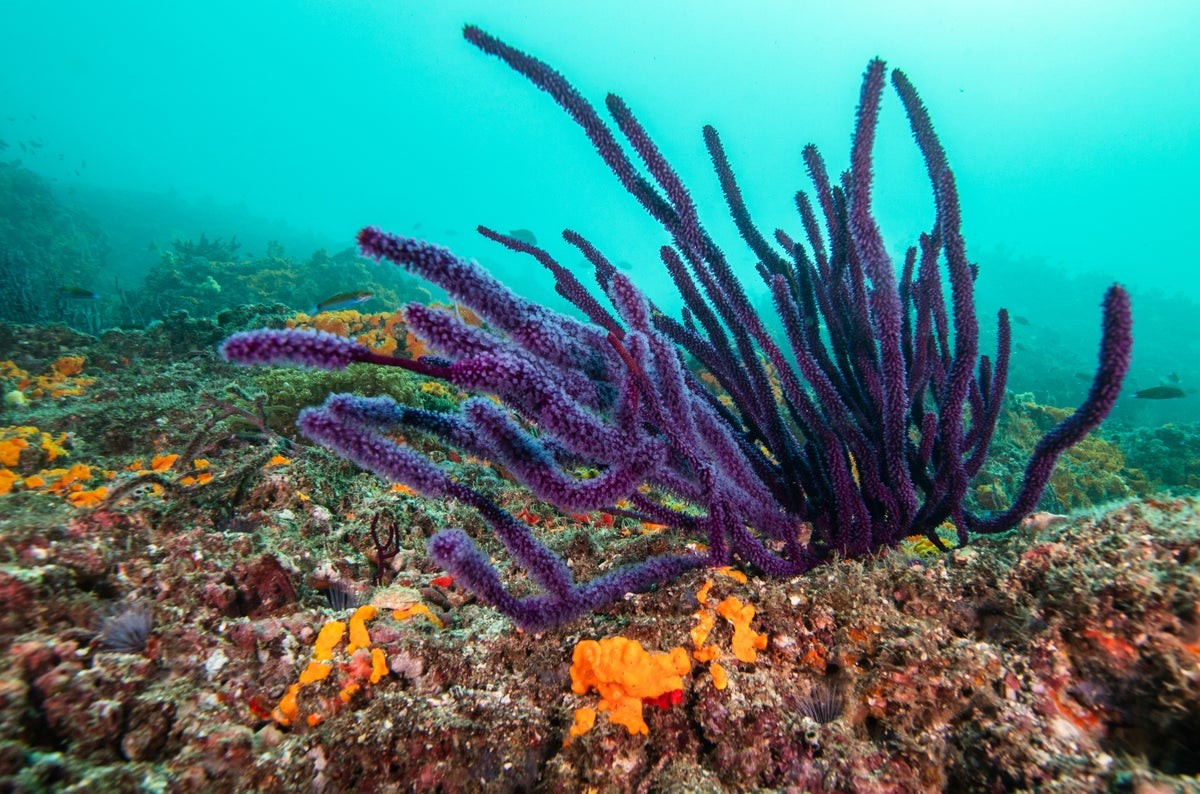
The local corals survived because they adapted fast. In a few thousand years they figured out how to live in hell.
“It’s like somebody built little laboratory out there for how tropica biota should behave in reaaly extreme climate.” — Bernhard Riegl
We need those genes.
By 2100 every tropical reef might look like the Persian Gulf does now. Hot. Salty. Bleaching. If we lose the Gulf’s secrets we lose the instructions on how other corals might survive the coming heat waves. We’re left with “evolutionary gold” as Riegl puts it.
It’s not just corals though.
Seagrass. Mangroves. Mudflats where migratory birds eat. In 2011 scientists found hundreds of whale sharks chilling in an oil field off Qatar. Later they found the largest known herd of dugongs. Giant sea cows.
The Strait of Hormuz is especially dense with life. The water flows in. It loops north up Iran’s steep coast then swings down the shallower Arabian side. This counter-clockwise flow changes everything. The water gets hotter. Saltier. So the Iranian side stays slightly cooler. More diverse.
It’s a sea of contrasts. Resilient. Fragile. Shokri says that duality makes it vital for conservation. And right now it’s failing.
Heat. Concrete. Oil.
Three things have been killing the Gulf for decades.
First is the heat. Starting in the late nineties heat waves kept hitting. They didn’t just pass through. They stuck around. Riegl estimates ninety percent of corals have bleached at some point. When they get stressed they spit out the algae that give them color. White skeletons.
Second is construction.
Riegl watches natural shorelines vanish under ports and sewage plants. Massive artificial islands sprout up like concrete weeds.
Third is pollution.
We’ve been doing this to ourselves since the first Gulf War. Millions of barrels of oil spilled. Some of it turned to bitumen. Hard tar. “Bitumen shorelines” is Riegl’s phrase. You scratch the sand and hit black goo.
Worse yet heat makes the oil worse.
Some scientists argue the Persian Gulf is now the most polluted sea basin on Earth. Oil suffocates mangroves. It confuses the sense of smell for turtles navigating home. It stops fish from reproducing.
Then came the desalination plants.
These huge factories pump out hot brine. The saltwater is so hot it sinks straight to the bottom. It kills everything there. Sterile seafloor.
And now?
War.
No one has precise data on how the new fighting is hurting things yet. Satellites see oil spills. More of them. Since attacks began in early this year the surface is stained.
The current doesn’t care about borders.
Oil moves in that same counter-clockwise loop. It goes everywhere.
“It’s just such a littlle puddle” Riegl says “It’s all connected.”
Shokri notes the damage won’t stay contained even if the targets are on Iran’s soil. It washes out. It washes in.
But here’s the weird part.
They aren’t gone. Not all of it.
Riegl sees corals still clinging to life after ten years of devastation. Small. Beaten. Looking like they’ve been through hell. But they are still there.
Maybe they can bounce back. Maybe the war finishes them off.
It’s a coin flip in a burning puddle.
We’ll see what the tide brings up. 🌊