The Sky Split Open
In late May, Massachusetts woke up to noise.
Then light.
Residents looked out windows expecting thunder. Or an earthquake. Maybe a military flyby. They saw a brilliant flash instead, followed by two sonic booms so loud they rattled houses and flooded 911 call centers.
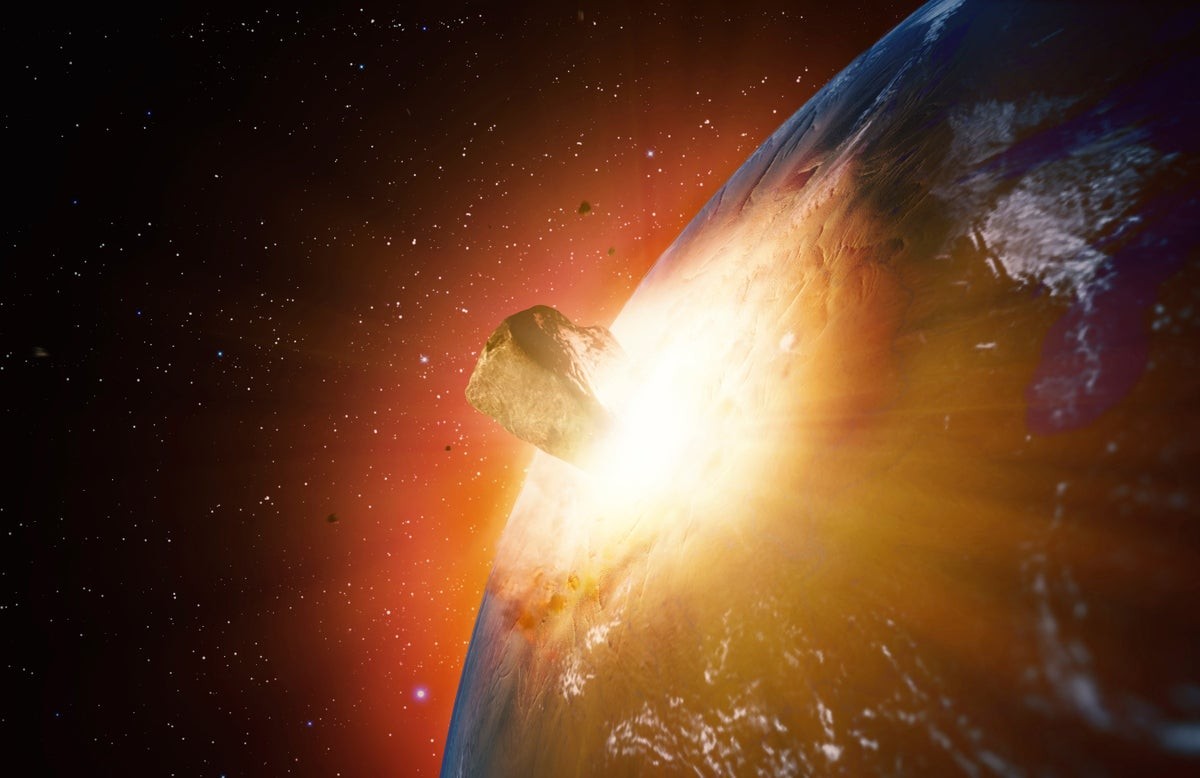
The cause was not local. It was a five-foot meteoroid, roughly the weight of an elephant, tearing through the atmosphere at 42,00 miles an hour. It exploded dozens of miles up. The pressure wave released the energy of 230 to 300 tons of TNT. Fragments likely drifted into Cape Cod Bay, ignored by most.
The event captured public attention. The Artemis II mission had already made space feel closer. But this wasn’t a success story. It was a reminder that the solar system is hostile. Full of flying projectiles. Earth sits in the middle of a celestial firing range.
Earlier that May, asteroid 2026 J2 passed within 56,000miles of Earth. It was tiny, 50 to 1415 feet wide. But it would have wiped out a major city if its aim was true.
Giants in the Night
We are safe from the small stuff for now.
Not the big stuff.
Stephen Hawking worried about impact events. He thought they posed a greater risk to humanity than pandemics or earthquakes. He wasn’t wrong. A six-mile asteroid hits once every 10 million years. That one killed the dinosaurs 66 million years ago.
Could we stop one?
No.
Deflecting a mountain-sized rock is like trying to halt a truck by throwing ping pong balls at it. We’ve cataloged most Near-Earth Objects larger than a half mile across. None are coming for us. Not that we know of.
Asteroids are discoverable. Comets are not. A new comet could emerge from the Oort cloud next week. Give us five years’ notice. We would have no idea how to deflect it. We’d just watch.
The real threat is medium-sized. Between 100 yards and a half mile.
These hit Earth once every 10,000 to 100 years. A 400 yard impact on Europe would erase a country like France from the map. The entire continent would burn.
This scenario is preventable.
If we want it to be.
Who Wants to Play Defense?
Dutch astrophysicist Piet HUT decided we shouldn’t wait for an apocalypse. After the films Deep Impact and Armageddon popularized the idea, Hut organized a workshop. He wanted real solutions. Not Hollywood scripts.
In 2002, he helped found the B612 Foundation. They planned a satellite named Sentinel. It was supposed to find dangerous asteroids before they became news. Funding ran out. The mission was canceled. But the foundation persists. They keep pushing.
Governments moved too, slowly.
NASA created the Planetary Defense Coordination office. The European Space Agency funded NEOShield. The UN established warning networks and planning groups.
Meetings happened. Papers were written.
Consensus was scarce.
Bad Ideas First
How do you deflect a rock?
Blowing it up with nuclear weapons seems dramatic. It looks great on screen. Armageddon did it. Real physics says no.
Nuclear blasts fragment asteroids. They don’t stop them. The debris continues moving in the same direction. Instead of one impact, you get ten. Or a hundred. The kinetic energy remains. The result is a shotgun blast from space.
Edward Teller proposed it. The hydrogen bomb father believed in big solutions. He was mistaken about the mechanics.
We need nudges. Small ones.
Astronomers calculated this with Asteroid Apophis. It looked like it might hit us in 209. A change in velocity of a few micrometers a second would miss Earth entirely. Turns out Apophis is fine. It passes safely in 209 at 20,00miles distance. No intervention needed.
But the method is valid.
Push it gently. Early enough, and you change everything.
NASA proved this works.
In September 02, the DART mission crashed into Dimorphos, a 5-foot asteroid. The impact altered its orbit around its parent body Didymos slightly. Just enough.
It was intentional. It succeeded.
Hardware Problems
We need better tools for later threats.
Lawrence Livermore National Lab is designing HAMMER. The Hypervelocity Asteroid Mitigation Mission. Think of it as a cosmic battering ram. Ten yards long. Nine tons heavy. You fire it into small objects.
If you have a 0-year warning, it deflects a 100 yard target.
Larger object? Fire ten HAMMers.
Fifty? Hundred?
Expensive?
Yes.
Does cost matter if it saves 0 million lives? No.
There are cheaper options. Less destructive ones.
Place a rocket motor on the asteroid. Extract hydrogen from ice and oxygen from rock inside the rock. Burn the fuel. The gas pushes back. The rock moves forward. Or backward. It’s basic Newton.
Or use sunlight.
Heat one side until surface material evaporates. The gas jets away. The asteroid drifts in the opposite direction. Like an ion drive. You can do this with laser satellites. Or mirrors.
Reflectors focus light. Heat creates thrust.
Paint the rock. Darken it. Increase absorption. Change its temperature profile. This modifies the Yarkovsky effect—the subtle push sunlight gives a spinning rock.
Subtle? Maybe.
Effective over time?
Likely.
The gentlest approach is the Gravity Tractor.
Imagine a massive probe flying next to an asteroid for years.
Decades.
Its gravity pulls the asteroid. A tiny tug. Constant. Cumulative.
The probe must maintain position using its own thrusters. Otherwise the asteroid’s gravity pulls the probe into a crash. It’s a delicate dance.
With enough time, it works.
Do we always have time?
Not really.
Politics of Survival
All this science sounds utopian.
It clashes with reality.
Imagine an asteroid aimed at Dallas.
Will China pay for its defense?
Will America spend billions to save Chengdu?
Do Europeans care if Zimbabwe is erased?
Carl Sagan saw this trap.
Planetary defense technology is also a weapon. If you can deflect a rock from your city, you can redirect it toward an enemy.
The UN committee discusses these tensions.
Not just physics.
Geopolitics.
The threat isn’t just cosmic.
It’s terrestrial.
Human nature complicates defense. We don’t share resources well. We fear each other.
We are not ready for a consensus.
We might never be.
The window for preparation is open now. It won’t stay that way.
Like climate change or viral pandemics, urgency arrives late. Often after the first casualties.
We hope for foresight. We should bet on inertia.
What do you do when the sky is darkening?