We usually picture them as harmless. Gangly. Weak. Maybe a little gross if you squint too hard, but definitely not a threat to anything larger than a speck of dust. We call them daddy longlegs. Or harvestmen. Arachnids that wander through your backyard nibbling on fungi, leaves, maybe a stray dead insect if they get lucky. Omnivores. Scavengers. Slow.
Forget that.
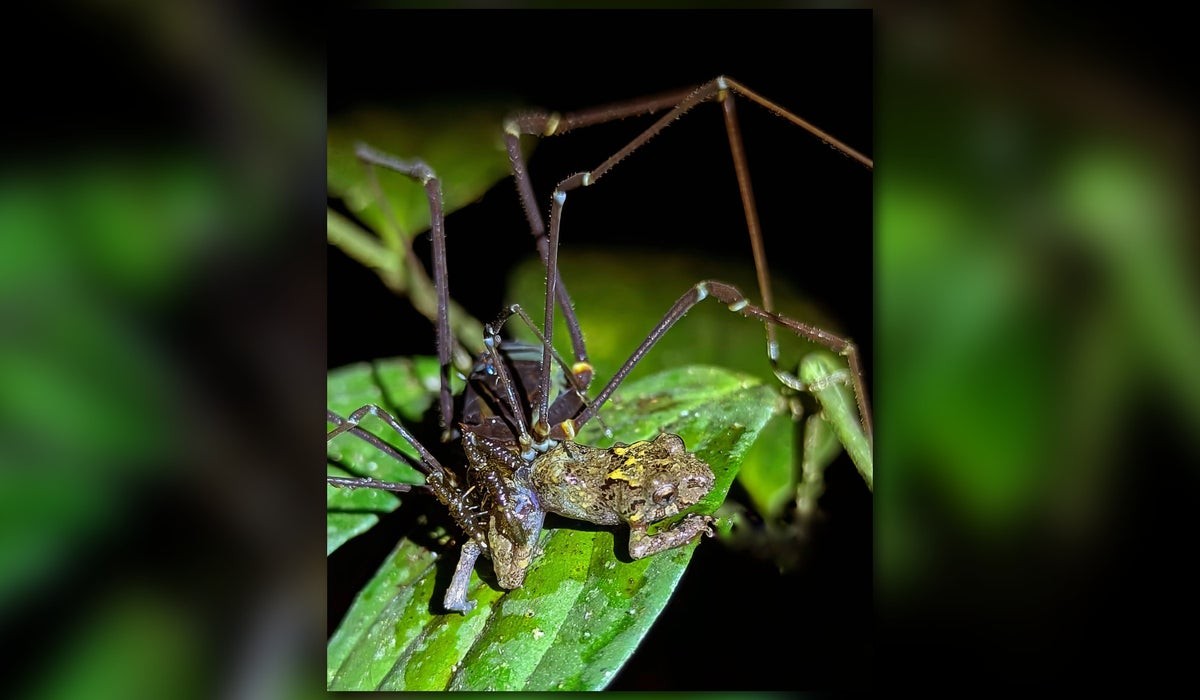
A new study in Ecology and Evolution flips the script. These creatures are predators. Actual predators. Of vertebrates. Specifically. Frogs.
Luís Fernando García, an arachnologue at the University of the Republic, admits they were stunned. “The literature says they are weak,” he notes. The old textbooks agree. Slow, clumsy, vegetarian-adjacent.
The first crack in the armor appeared back in 2008. Osvaldo Villarreal, García’s co-author and an arachnologist based in Venezuela, saw something impossible. In a Venezuelan national park, a harvestman had pinned down a rain frog. Not just found a dead one. Pinned it. The footage showed a small arachnid wrestling a struggling amphibian. Villarreal calls it a “real wow moment.” It wasn’t subtle. It was shocking.
Then came Brazil. About a decade later, another team saw the same thing. A harvestman. A frog. Lunchtime.
Between 2020 and 5, researchers in Ecuador and Colombia joined the party. They found multiple species of harvestmen feasting on frogs. Not once. Not twice. Multiple times.
“We found that it might not be so occasional,” García says.
This changes things.
Previously, we assumed if a spider relative found a frog, the frog had already expired. Scavenging. A lucky meal. But the compiled sightings show live prey. Often still struggling when the harvestman starts biting. This suggests hunting. Active, intentional predation.
It hints that they are hunting rather than scavenging.
So how?
That is the weird part. How do you hunt something that leaps? Frogs are strong. Athletic. Exploders. Daddy longlegs look like they would fold under a gentle breeze. They don’t have venom. No spider poison. No scorpion sting. Their mouthparts are basically tiny pincers meant for grinding down mold or chewing on beetle wings.
Jose Valdez from the German Center for Integrative Biology was not on the team. He calls it puzzling. “How are unathletic arachnides capturing leaping prey?” he wonders.
Maybe size matters. Tropical harvestmen are bigger. Bulkier. Tank-like compared to the twig-thin cousins we see in temperate forests. They have armored shells. Spiked legs. Maybe they use that bulk to restrain the frog. Crush it. Hold it still. Then bite.
But we don’t really know. Not fully. They are understudied. Invisible, mostly. Because we assume they’re boring.
“There is so much we do not know,” Valdez admits. Despite being everywhere. Your yard. Their forests. Everywhere.
The bias runs deep. We study what we understand. Usually things that live where we live. Temperate zones. Cold winters. Simple food chains.
But in the tropics, the rules break down. Food webs there aren’t straight lines. Invertebrate eats plant. Insect eats invertebrate. Vertebrate eats insect. No. The table flips. The small things eat the big things. The weak-looking things kill the strong-leaping things.
We looked at them and saw junk. Nature looked closer. It saw teeth. Or something close enough.