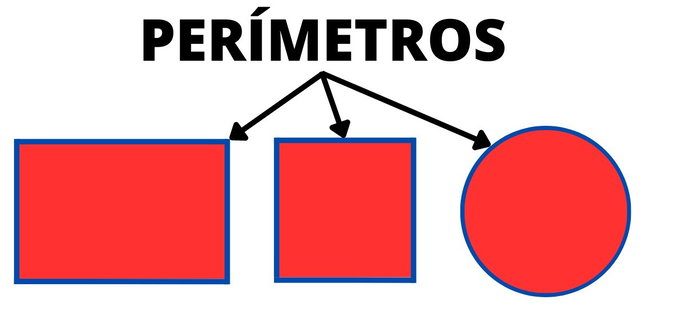
In math, perimeter is straightforward. It’s the total distance around the edge of a shape. Think of it as the boundary line that keeps the inside safe. You find it by adding up the lengths of all the sides of a flat geometric figure.
For simple shapes like a square or a rectangle, you just add the side lengths together. A circle is different. Its “sides” are curved, so we use a specific formula for its perimeter, which we call circumference.
Why Perimeter Matters in Real Life
You might think perimeter is just for school tests. It’s not. It’s everywhere.
Need to put a fence around your backyard? You calculate the perimeter to know how much material to buy. Want to frame a picture? You measure the perimeter to get the right size frame. Even tying a ribbon around a gift box requires a quick perimeter check.
It’s practical. It’s useful. It’s not just numbers on a page.
Breaking It Down
Let’s look at a square. All four sides are equal. If one side is 5 inches, the perimeter is 5 + 5 + 5 + 5 = 20 inches.
A rectangle? Two sides are length, two are width. Add them all up.
A circle? Use pi (3.14) times the diameter. That’s the perimeter for a curved edge.
Don’t Overcomplicate It
Students often get stuck on complex shapes. Start simple. Master the square. Then the rectangle. Then the triangle. Once you see the pattern, it clicks.
Perimeter isn’t about memorizing formulas for every weird shape. It’s about understanding that it’s just the outside measurement. Add the sides. That’s it.
Why does this matter? Because real-world problems don’t always give you the formula. They give you a problem. You have to figure out the boundary.
Start with the basics. Build from there.
The hidden boundary of 3D shapes
Flat figures have edges. You can trace them with your finger. Three-dimensional bodies? They don’t have a perimeter in the traditional sense. They have faces. And faces have area.
It’s a distinction that trips people up. But it’s logical. A cube isn’t outlined by lines; it’s bounded by squares.
The word itself gives it away. Perimeter comes from the Greek περίμετρος. Break it down. Peri means around. Metron means measure. So, literally, measure around.
But you can’t measure around a sphere. You measure across its surface.
How to calculate perimeter for flat figures
You need two things before you start crunching numbers.
First, the count of sides.
Second, the length of those sides.
If you have a regular polygon, the math is simple. You multiply the side length by the number of sides.
$$P = L \times n$$
Here is what that looks like in practice:
- P is your total perimeter.
- L is the length of one side.
- n is how many sides exist.
Simple. Direct.
But what if the sides are uneven? Or missing?
You can still find the perimeter if you know the area, though the path is longer. It requires working backward. For circles, you don’t count sides. You need the radius or the diameter. Without that specific data point, the calculation stops.
Perimeter of a circle
A circle is deceptive. It’s a flat shape, closed by a curve. Every point on that line is equidistant from the center.
The circle is the space inside. The circumference is the line itself. When people ask for the perimeter of a circle, they are actually asking for the circumference. The boundary. The edge.
The formula relies on pi.
$$C = 2 \pi r$$
Or, if you prefer working with the full width:
$$C = \pi d$$
It’s not just about the number. It’s about the relationship between the radius and the constant that defines the curve.
Squares, rectangles, and triangles
Polygons are where it gets practical.
For a square, all sides are equal. Multiply one side by four. Done.
A rectangle has two pairs of equal sides. Add the length and width together, then double the result.
$$P = 2(l + w)$$
Triangles vary. The equilateral triangle is easy—three equal sides. The isosceles triangle has two equal sides. The scalene triangle has none. For scalene, you just add all three distinct lengths together.
Then there’s the rhombus. It’s a parallelogram with four equal sides. Like the square, but slanted. The math remains the same. One side length times four.
These are the basics. The foundation.
But why do we care? Is it just for tests?
Maybe. Or maybe it’s for measuring the fencing needed for a garden. Or the trim for a room. It’s about knowing the limit. The edge. Where the shape ends and the world begins.
Most people forget that distinction. They treat a 3D object like a
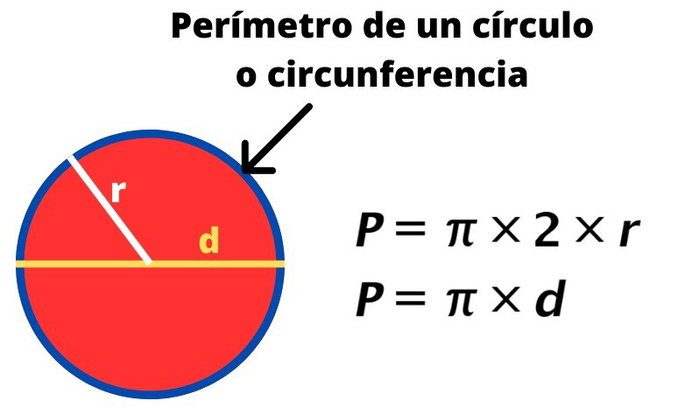
The variable π represents pi. The variable r stands for the radius of the circle. The variable d is the diameter. Let’s look at a concrete example. Take a circle with a radius of 7 cm. The perimeter calculation follows directly from these values.
Check out the articles on Circle and Diameter for more context.
How to Find the Perimeter of a Square
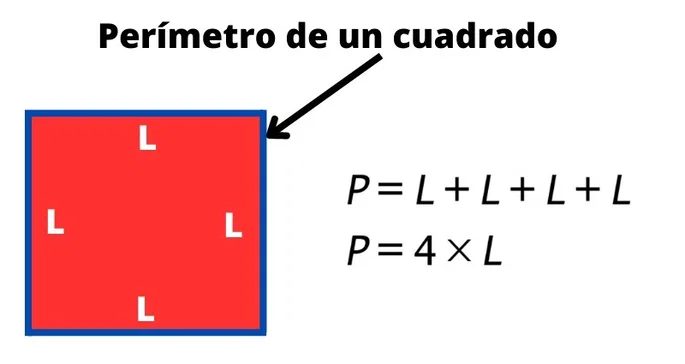
A square is a flat geometric figure. It has four equal sides. The perimeter is simply the sum of these sides.
The formula for calculating the perimeter of a square is:
How to Find the Perimeter of a Square
Start with the basics. A square is straightforward because every side is identical. You already know that L represents the length of each side. When you have a square with sides measuring 5.5 cm, finding the perimeter is simple multiplication. You just multiply the side length by four.
$$P = 5.5 \times 4 = 22 \text{ cm}$$
This works because you are essentially adding the same number four times. It’s the most efficient way to calculate distance around a shape where symmetry is guaranteed.
Why Rectangle Perimeters Require a Different Approach
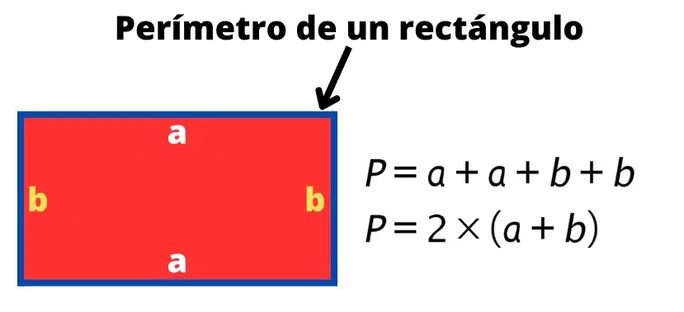
Rectangles don’t play by the same rules. They have four sides, but unlike the square, two are different. You have a height and a width. This means you can’t just multiply one number by four. You have to account for the variety.
The perimeter of a rectangle is simply the sum of all its sides. But adding them up one by one is inefficient when you know the structure. Since opposite sides are equal, you can group them.
The Formula for Rectangle Perimeter
Here is the exact formula to calculate the perimeter of a rectangle:
$$P = 2 \times (\text{height} + \text{width})$$
Or, written differently:
$$P = 2h + 2w$$
This approach saves time. Instead of measuring each side individually and adding them, you add the height and width once, then double the result. This works because you’re covering both vertical sides and both horizontal sides simultaneously.
Think of it like walking around a block. You walk up one side, across the top, down the other side, and back across the bottom. If you know the length of the blocks, you can predict the total distance without counting every step.
This formula applies whether you’re tiling a floor, framing a picture, or calculating the fencing needed for a garden. It’s a universal rule for any flat, four-sided shape with opposite equal sides.
Remember, accuracy matters. If your measurements are off by even a fraction, your total perimeter will be wrong. Double-check your numbers before multiplying.
What happens if you have a shape that isn’t a perfect rectangle? The logic still holds, but you’d have to add each side individually. Geometry is flexible, but formulas are strict. Stick to the rules.
El cálculo del rectángulo en números
Vamos a ponerle carne al hueso. Si tienes un rectángulo donde el lado corto a mide 2 cm y la altura b alcanza los 8 cm, el perímetro no es un misterio. Solo sumas todos los bordes. Dos lados de 2 y dos de 8. El total es 20 cm.
Pero hay otra figura que suele confundir a los estudiantes por su simetría. El perímetro de un rombo requiere un ojo atento.
Cómo calcular el perímetro de un rombo
Un rombo se parece mucho a un cuadrado. Tiene cuatro lados iguales. La diferencia clave, esa que te hace perder puntos en un examen de geometría básica, son los ángulos. No son rectos. Son agudos y obtusos.
A pesar de esa inclinación, la regla de oro sigue siendo simple. Como todos los lados miden lo mismo, el cálculo es idéntico al del cuadrado. Multiplicas la medida de un solo lado por cuatro.
Si no sabes medir los lados, el área te servirá para encontrar la longitud del lado y luego el perímetro.
La belleza de esta figura es que la oblicuidad no cambia la longitud del borde. Extiendes los lados hacia afuera y la distancia total alrededor sigue siendo cuatro veces la unidad. No necesitas ángulos para medir el contorno. Solo necesitas la longitud de uno de ellos.
Esto simplifica la vida cuando resuelves problemas prácticos. ¿Por qué complicarse midiendo cada lado si son idénticos? La clave está en reconocer la estructura antes de tocar la calculadora.
La forma cambia, el ángulo se deforma, pero la suma perimetral permanece fiel a la multiplicación básica. Es una de esas verdades geométricas que pasan desapercibidas hasta que necesitas resolver un problema de ingeniería o diseño rápido.
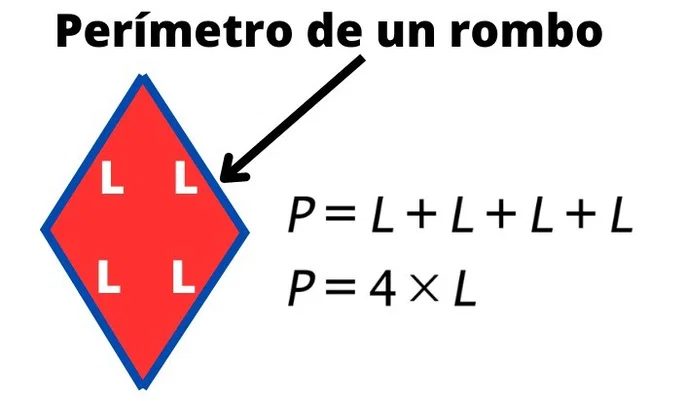
Si ya sabes que el perímetro de un rombo se calcula multiplicando la longitud de uno de sus lados por cuatro ($4 \times L$), el siguiente paso lógico es enfrentar otra figura común: el triángulo equilátero.
Aquí las reglas son simples, pero entender por qué funcionan hace que el cálculo sea mucho más rápido.
Perímetro de un triángulo equilátero
Un triángulo equilátero no es solo cualquier triángulo. Es una figura donde los tres lados tienen exactamente la misma longitud. Esto elimina la necesidad de medir cada borde por separado.
La fórmula del perímetro del triángulo equilátero se deriva directamente de esa simetría:
$$P = 3 \times a$$
Donde a es la medida de uno de los lados.
Por ejemplo, si tienes un triángulo equilátero con lados de 5 centímetros, no sumas 5 + 5 + 5 manualmente. Multiplicas.
$$P = 3 \times 5 = 15 \text{ cm}$$
Esto funciona porque, por definición, todos los lados son idénticos. Si un lado mide “a”, el segundo y el tercero también miden “a”. Por eso, la multiplicación por tres es el atajo matemático exacto.
No necesitas medir los tres lados si sabes que la figura es equilátera. Medir uno es suficiente.
La diferencia clave con el rombo es que, mientras que el rombo puede tener ángulos diferentes (aunque los lados sigan siendo iguales), el triángulo equilátero impone restricciones en los ángulos también (60 grados cada uno). Pero para el perímetro, la regla de oro sigue siendo la misma: todos los lados iguales significa multiplicar el lado por el número de lados.
Esto simplifica enormemente el proceso de cálculo. En lugar de una suma larga, es una sola operación. ¿Por qué complicar las cosas cuando la geometría básica ya te da la solución directa?
Si estás practicando con figuras más complejas, esta lógica de identificar lados iguales antes de sumar te ahorrará tiempo y errores. La próxima vez que veas un triángulo, verifica primero si es equilátero. Si lo es, olvida la suma. Multiplica por tres.
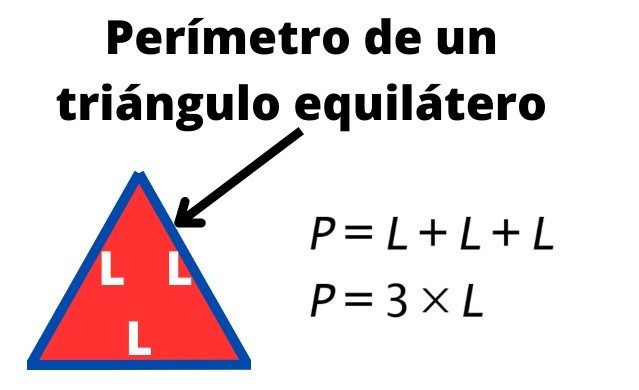
Let $L$ be the length of each side. For instance, if there is an equilateral triangle with sides measuring 9 cm, the perimeter would equal:
See also Equilateral triangle, Square, and Geometric shapes.
Perimeter of an isosceles triangle
An isosceles triangle is defined by having two sides of equal length. To find the perimeter, you sum those equal sides and the one with the different length.
In this case, the formula to calculate the perimeter of an isosceles triangle is:
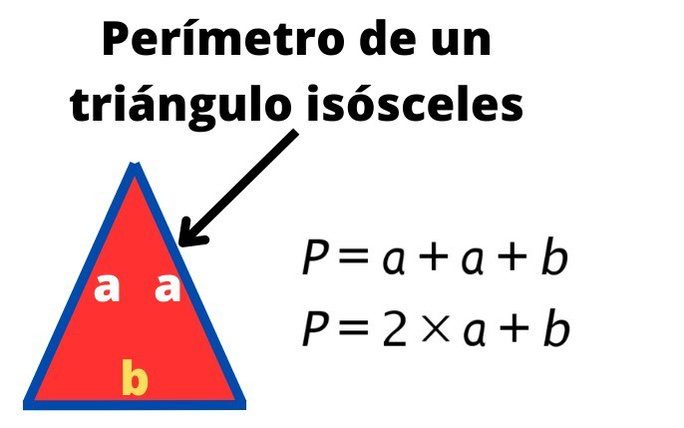
Start with the basics of the isosceles triangle. You have two equal sides, labeled a, and one different side, b. Add them up. The math is straightforward.
Take a specific example. A triangle with sides measuring 37, 37, and 15 cm.
37 plus 37 is 74. Add 15. The perimeter is 89 cm.
Perimeter = 2a + b
This formula works for any isosceles shape. Just double the equal side and add the base.
Calculating the Perimeter of a Scalene Triangle
Scalene triangles are different. All three sides are unequal. No symmetry here.
If you need to find the perimeter, you can’t skip steps. You must measure or know every single side length.
The formula is simple addition.
P = a + b + c
Where a, b, and c are the lengths of the three distinct sides.
Unlike the isosceles case, you don’t multiply anything. You just sum the parts.
This matters for students solving geometry problems. It also helps anyone measuring irregular shapes for construction or design.
Know your triangle type first. Then apply the right logic.
Isosceles? Double the equal side.
Scalene? Add them all up.
Right? Isosceles? Double the equal side.
Scalene? Add them all up.
P = a + b + c
This rule holds true regardless of angle sizes. Acute, obtuse, or right-angled, the perimeter calculation remains a sum of lengths.
Why does this distinction matter? Because mixing up formulas leads to errors. Assume symmetry where none exists. You’ll get the wrong answer.
Check the sides.
- Two equal? Use 2a + b.
- All different? Use a + b + c.
It’s not about guessing. It’s about observation.
Measure carefully.
Label clearly.
Compute accurately.
The shape dictates the method.
Don’t just memorize. Understand which sides interact.
In an isosceles triangle, two sides mirror each other. In a scalene triangle, every side stands alone.
This difference changes nothing about the concept of perimeter. It’s still the distance around the outside.
But it changes the shortcut.
Use the shortcut when it fits.
Skip it when it doesn’t.
Precision wins.
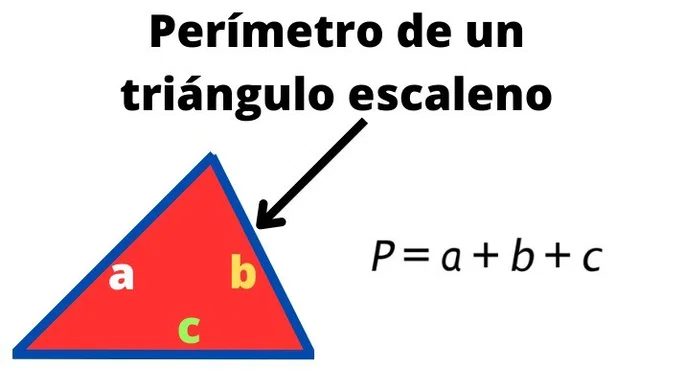
Calculating the perimeter of a scalene triangle is straightforward once you know the formula. For any triangle, the perimeter is simply the sum of the lengths of its three sides. In this case, we are working with a scalene triangle where all sides have different lengths: 3 cm, 4 cm, and 6.5 cm.
Why This Matters for Students
Understanding how to calculate the perimeter helps students grasp basic geometry concepts. It also reinforces addition skills with decimals, which is a common point of confusion for learners.
How to Calculate It
- Identify the lengths of all three sides.
- Add them together.
In our example:
3 + 4 + 6.5 = 13.5 cm
So, the perimeter of this scalene triangle is 13.5 cm.
Common Mistakes to Avoid
One common mistake is forgetting to include all three sides. Another is misplacing the decimal point during addition. Always double-check your calculations.
“The perimeter of a triangle is the total distance around its edges.”
This simple rule applies to all triangles, regardless of type. Whether equilateral, isosceles, or scalene, the method remains the same.
Practice Makes Perfect
Try calculating the perimeter of other triangles with different side lengths. Start with whole numbers, then move to decimals. This will build confidence and accuracy.
Final Thoughts
Perimeter calculations are foundational in geometry. Mastering them early on sets the stage for more complex topics like area and volume. Keep practicing, and you’ll find these problems become second nature.