An angle is the distance between two straight lines starting from the same point. These lines are called sides. The point where they meet is the vertex.
Think of a clock. The hour and minute hands share the center point. Over time, the tips of the hands separate from each other. This creates different gaps between them. These openings are angles.
We measure these angles in degrees. This number indicates the distance between two lines. The more open the lines are, the higher the number of degrees.
You need a tool to measure this gap. It is a semicircular or circular device called a protractor. The result is a number followed by a degree sign. 25° means 25 degrees.
Classifying Angles by Opening
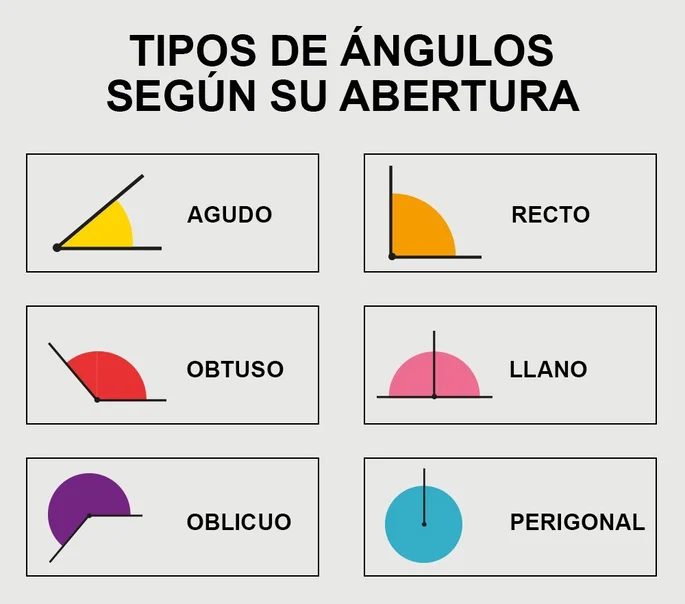
Angles are divided into categories based on their size. They are also grouped by position and relation to other forms. This is what they look like based on the number of degrees.
Acute Angles
The acute angle is small. It measures less than 90 degrees. Think of a paper corner, but acuteer. It’s a tight gap. A 30° angle is acute. The 89° angle is also acute.
Straight Angles
A straight angle is exactly 90 degrees. It has a perfect L shape. This is the most common angle seen in rooms and on paper. When you fold a square piece of paper in half, you create a straight angle. It is a standard measure for straight lines that meet at a perpendicular intersection.
Blunt angles
An obtuse angle is wider than a straight angle, but smaller than 180 degrees. It’s an open, wide mouth. A 100° angle is obtuse. A 179° angle is almost a straight line, but is still classified as obtuse. It is located between a straight angle and a straight line.
Straight Angles
A straight angle is exactly 180 degrees. Both sides form one straight line. They point in opposite directions. There is no “opening” in the traditional sense. It’s just a line. You can think of it as a flat surface or an unfolded book.
Reflex angle
The reflex angle is greater than 180 degrees but less than 360 degrees. It is the “outside” of the standard angle. If you draw a line and turn it past the straight point, you get the reflex angle. An angle of 200° is a reflex. It encloses more than half a circle.
Full rotation angle
A full rotation is 360 degrees. The sides meet again at the starting point. You’ve come full circle. This will take you back to where you started. It’s a complete turn.
Why are these differences important? Knowing the type makes it easier to recognize the shapes. It helps in construction. It is important in geometry problems. You can’t solve a triangle without knowing whether an angle is acute or obtuse.
A protractor is your best friend here. Set the center point to the vertex. Align one side with the zero line. Read the degree where the other side crosses the scale. Simply. Effective.
But there’s more to angles than just size. Position is also important. How they
Classifying angles isn’t just memorizing a list. It’s about understanding the space between two intersecting lines. Whether you’re doing geometry homework or visualizing architectural plans, knowing the exact degree of an opening makes all the difference.
The rating is divided into clear, unambiguous categories based on degrees. This is how the corners stack up.
Angles classified according to degrees
The easiest way to sort angles is by their numerical value. This method removes the ambiguity. You look at the protractor and place the angle in its correct bin.
- Zero Angle : This is the starting point. Its dimensions are 0 degrees. There is no gap between the lines. They lie on top of each other.
- Acute Angle : Think “small”. These angles are less than 90 degrees. They are sharp and narrow.
- Right Angle : This is the scale. It measures exactly 90 degrees. It is the corner of the square or the edge of the paper.
- Obtuse angle : Larger than a right angle but not a straight line. It is 90 to 180 degrees.
- Right angle : A straight line. Its dimensions are 180 degrees. Both rays point in opposite directions.
- Reflex angle : In some contexts it is also called an oblique or concave angle. This angle exceeds 180 degrees, but stays under 360 degrees. It looks like a Pac-Man shape with its mouth open.
- Perigonal Angle : Full circle. Its dimensions are 360 degrees. This is the maximum possible angle.
Key Takeaway: The difference between an obtuse angle and a reflex angle is the 180 degree threshold. One is “open” but not full. The other is almost full, leaving a small gap.
Corners classified by location
Once you know the size, the next level of understanding is how the angles relate to each other in space. This is where according to position comes into play.
In location-based classification, the exact degree is irrelevant. It’s about the relationship. Do the corners touch? Do they have a sharing a vertex? Do they add up to a certain amount?
This approach is crucial for solving complex geometric proofs. It helps you see connections that can be hidden through degree measurements alone. For example, two angles can be 30 degrees and 150 degrees. In terms of degree, they are completely different (acute vs. obtuse). However, due to their position, they can be supplementary, meaning that together they form a straight line.
Understanding this dual classification system—first by degree, then by position—gives you a comprehensive toolkit. You can recognize the shape of the corner and immediately understand its role in the larger figure.
When perspectives share the page, things get special
It helps to think of corners not only as static shapes, but also as neighbors. The rules vary depending on how much space they share.
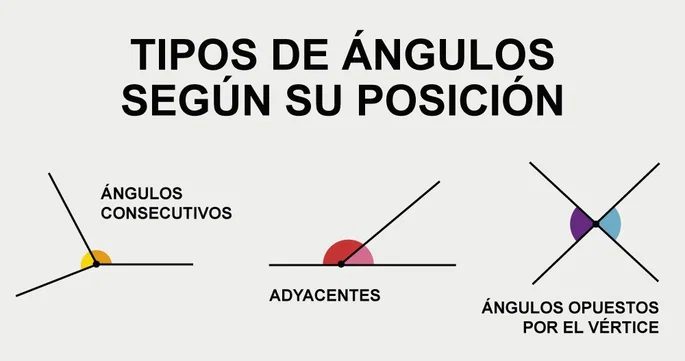
Consecutive angles are the basics. They sit adjacent and share one vertex and exactly one side. That’s it. They don’t have to be anything special. They just have to touch each other.
Adjacent angles are a tighter subset of this group. They also share a vertex and a side, but there’s a catch: they have to form a straight line. Their sum is always 180 degrees. When consecutive angles add up to 180°, they are called “adjacent”. Not all consecutive angles are adjacent. Only those who form a line.
If angles have a common vertex and side, but do not form a straight line, they are consecutive. If they form a straight line, they are adjacent.
Opposite angles are completely different. They only share the vertex. Sides do not coincide. They are facing each other at the intersection.
The logic behind the sum
Why is the 180 degree rule important for adjacent angles? It’s about geometry in motion. Imagine a straight line. Now draw a ray starting from any point on this line. You have just divided a straight 180 degree angle into two parts.
These two parts are adjacent. Together, they take back all 180 degrees from where they started. This is why adjacent angles are often called linear pairs. They are literally pairs that form a line.
Consecutive angles are not subject to this restriction. One side can have two angles that add up to 90 degrees (complementary), 300 degrees, or any number. They are just neighbors. Adjacent angles are neighbors with a specific task: to complete a straight line.
Opposite angles take this a step further into vertical space. When two lines intersect, they form four angles. Angles directly opposite each other are vertical angles. They share the vertex. They don’t share sides. An important feature here is that the vertical angles are always the equal in measure. If one is 40°, the other is also 40°. However, the one next to it is 140°.
We can also sort angles based on what happens when they are combined. These are not just academic details. It’s important if you want to understand how shapes fit, how unknown values are calculated, or why an angle looks the way it does.
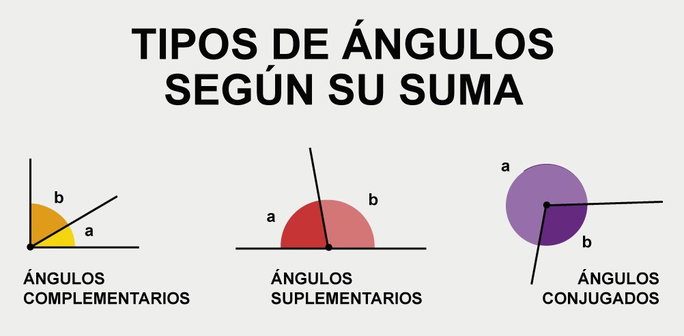
The three main categories depend solely on the total.
Complementary, Supplementary, and Conjugate Angles
The most common pair are complementary angles. Two angles are complementary if they add up to exactly 90 degrees. Think about the corner of a square. When you draw a line from this angle to the opposite side, you divide the right 90 degree angle into two smaller parts. These two parts complement each other. They complement each other and form a perfect right angle.
Supplementary angles take it a step further. They add up to 180 degrees. This is a straight line. When two adjacent angles have a common side and their outer edges form a straight line, they are supplementary. Together they form a “flat” angle.
Then there are conjugate angles. These occur less frequently in basic geometry, but are still clearly defined. They add up to 360 degrees. Basically, they come full circle.
Angles in circles: Central angles, Inscribed, and Semi-Inscribed
Position changes the name. As we move from straight lines to curves, especially circles, the classification changes according to the location of the corner apex.
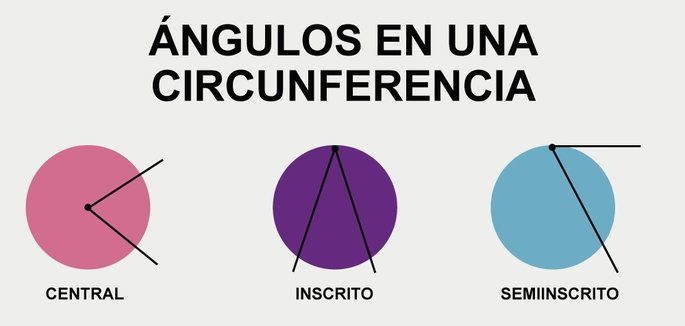
Consider a circle. You can set the angle to its center and edge in three different ways.
Central angles are simple. The vertex is exactly in the center of the circle. The sides of an angle are radii that extend to the circumference. The measure of this angle is directly proportional to the arc it cuts.
Inscribed angles are more difficult. Here the tip is not in the middle. It sits on top of the circle itself. The sides of an angle are secants – lines that intersect the circle at two points. The most important rule here is that the measure of an inscribed angle is half the measure of the arc that intersects it. It is a consistent relationship regardless of where the vertex of the circle is located.
Semi-inscribed angles are somewhere in between. The peak is also in the circle. But instead of two secants, one side is a secant and the other is a tangent. The tangent touches the circle at exactly one point – the vertex itself. This creates a specific geometric constraint that determines the angle’s dimension with respect to the cut arc.
Why is this distinction important? Because each type interacts with the circle differently. Central angles give you full arc measure. Inscribed angles halve it. Semi-inscribed angles obey the hybrid rule tied to the tangent line.
Knowing what type you’re dealing with will help you calculate exactly what’s missing. It takes the guesswork out of geometric problems. It turns a vague shape into a series of solvable equations.
The geometry of the circles is rigid. The rules don’t change. If you know the position of the vertex, you know the rules to apply. This clarity makes these classifications useful and not just labels for a textbook.
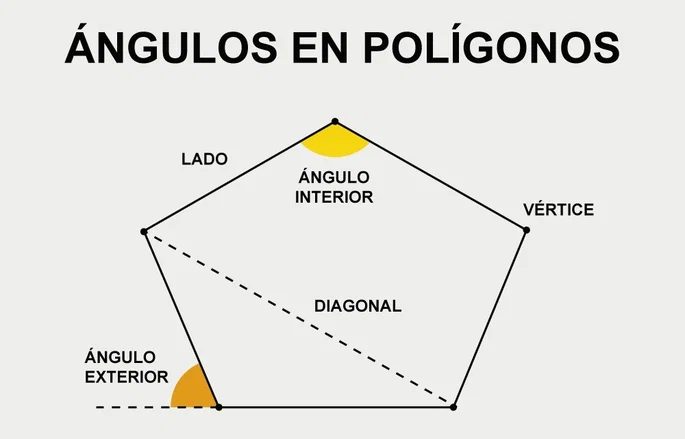
Interior and Exterior Angles: The Two Sides of Every Corner
When you look at a polygon, you’re really looking at a collection of intersecting lines. But those intersections create two distinct types of angles. Knowing the difference isn’t just about passing a geometry test—it’s about understanding the shape’s actual structure.
What is an Interior Angle?
The interior angle is the one hiding inside. It’s the space between two adjacent sides of the polygon, right where the vertices meet. If you were to walk along the perimeter of a shape, the interior angle is the turn you make inside the boundary.
In a standard convex polygon (like a square, triangle, or hexagon), these angles are always less than 180 degrees. They define the “tightness” of the shape’s corners. A sharp triangle has small interior angles. A wide, flat polygon has larger ones. But they all stay within that internal zone.
What is an Exterior Angle?
The exterior angle lives outside. It’s formed by one side of the polygon and the extension of an adjacent side. Think of it as the angle you create when you extend a line outward from a vertex.
Here’s the key: interior and exterior angles at the same vertex are supplementary. They add up to exactly 180 degrees. If the interior angle is 120 degrees, the exterior is 60. If the interior is 90, the exterior is 90. They’re partners. Flip one, and the other changes.
Why Does This Distinction Matter?
You might wonder which one to use when calculating properties of a shape. The answer depends on what you’re trying to find.
For example, if you’re trying to figure out how many sides a regular polygon has, exterior angles are often the easier path. There’s a rule: the sum of all exterior angles in any convex polygon is always 360 degrees. No matter how many sides the shape has.
So if you know the measure of one exterior angle, you can divide 360 by that number to get the total number of sides. Simple. Direct. No complex algebra required.
Interior angles, on the other hand, are used when you’re calculating the total sum of all corners. The formula here is $(n-2) \times 180$, where $n$ is the number of sides. It’s useful. But it requires knowing $n$ first.
How to Identify Them Quickly
- Look at the vertex.
- The angle inside the shape’s boundary is the interior.
- The angle outside, formed by extending one side, is the exterior.
They share the same vertex. They share a side. They are two halves of a straight line.
Practical Example
Take a regular pentagon. Each interior angle is 108 degrees. Each exterior angle is 72 degrees. Add them: 108 + 72 = 180. Correct.
Now take the sum of all exterior angles: 5 sides × 72 degrees = 360 degrees. Always 360.
This consistency is why exterior angles are often preferred for certain calculations. They don’t change with the number of sides. The sum stays fixed.
The Learning Economy: Why Context Matters More Than Content
We often treat knowledge like a commodity. Buy the course. Download the PDF. Collect the certificate. But here is the thing. Context is where the magic actually happens. A fact sitting in a vacuum is useless. It needs a home. It needs a reason to exist.
Consider the difference between memorizing a historical date and understanding the geopolitical tension that led to it. One is data. The other is wisdom. And wisdom? That sticks.
This is the core argument for active contextual learning. It’s not just about what you know. It’s about how you connect it to what you already know. When you anchor new information to existing neural pathways, you aren’t just storing files. You are building a web. And the stronger the web, the harder it is to break.
Connecting the Dots: The Neuroscience of Association
Why does this work? It’s simple biology. Your brain craves patterns. It hates noise. When you learn something new in isolation, your brain labels it as irrelevant. It gets archived in the digital equivalent of a junk drawer. But when you link that new idea to something you love, or something you struggle with, or something you’ve already mastered, you create a hook.
Think of it like organizing a closet. If you throw all your shirts in a pile, you’ll never find what you want. But if you hang them by color, by season, by style? Suddenly, you have a system. Learning works the same way.
“Information becomes knowledge only when it is integrated into your existing mental models.”
This integration isn’t passive. It requires effort. You have to ask questions. You have to make weird, unlikely connections. Why does this coding principle remind me of how my garden grows? Why does this economic theory mirror my family dynamics? These questions might seem silly. They aren’t. They are the glue.
Moving Beyond Rote Memorization
Rote memorization has its place. Sure, you need to know your multiplication tables. You need to know the capital of France. But once you have those basics, you need to move on. You need to apply them.
Here is a practical shift. Stop trying to memorize the definition of a concept. Start trying to explain it to someone else. Use a metaphor. Draw a diagram. Teach it to your dog if you have to. The act of translation forces your brain to simplify, to clarify, to understand the core structure of the idea.
This is contextual application. It’s the difference between knowing the ingredients of a cake and actually baking it. You might know the recipe by heart. But if you’ve never mixed the batter, you don’t really know how to bake.
The Role of Failure in Deep Learning
We fear failure. In school, it’s penalized. In the workplace, it’s often hidden. But in deep learning, failure is data. It’s feedback. When you try to apply a concept in a new context and it doesn’t work, you learn more in that ten seconds than you would in ten hours of passive reading.
Why? Because you are forced to confront the gaps in your understanding. You realize you didn’t actually grasp the nuance. You thought you did. You were wrong. And correcting that error strengthens the neural pathway far more than getting it right the first time on a