Lev Vygotsky didn’t just watch children play; He watched as they talked, argued, and built. For the psychologist born in Russia between 1896 and 1934, learning was not a solitary assimilation of facts, but a social event. His theory suggests that we don’t just think in our heads. We think through the culture and community around us.
This idea did not arise in a vacuum. It emerged in parallel with Marxist thought, which was deeply interested in how society shapes human development. Vygotsky argued that your cognitive growth is directly related to your social environment. Socialization makes you who you are. An individual is a product of his interaction.
Four levels of analysis
Vygotsky did not see development in a straight line. He used a genetic comparative method and an experimental evolutionary approach to find out how we grow. He identifies four different areas of analysis to reflect this complexity.
First, there is the phylogenetic layer. This is about the origin of the psychological functions of humans as a species. It is the comprehensive evolutionary history of our mind.
The second is the historical-socio-cultural context. Where are you? When are you? These factors determine your integration into the world.
Then comes the ontogenetic level. This includes the biological and socio-cultural development of an individual’s life. It’s your personal timeline.
Finally, the microgenetic field focuses on the specific psychological characteristics of an individual at a given time. It is here and now.
Each layer interacts with the others. You can’t understand one without the others.
The power of communication and language
An integral part of this framework is the concept of mediation. We use tools and signs to bridge the gap between social interaction and personal development. The most powerful of these tools is Language.
Language is not just a way of describing the world. It shapes how we think about it. We internalize social experiences with the help of language. We turn external conversations into internal thoughts.
This leads to the idea of co-construction. Knowledge isn’t handed down from the teacher to the passive student. It’s being assembled. The individual and the social group work together to create understanding.
Knowledge is a collaborative product, not a solitary discovery.
Innate skills vs. learned patterns
Vygotsky did not claim that the mind is a blank slate. He acknowledged that we are born with a certain mental equipment. Perception, attention and memory are innate abilities. You don’t learn to see or focus; You are equipped to do this right from the start.
However, these raw capacities require a host. They develop fully only through social interaction. A child may have an innate ability to remember, but learn to use memory strategies by observing others.
This brings us to a crucial distinction. Thought patterns are not innate conditions. They are social constructs. The way you reason, solve problems and categorize the world is learned from the culture in which you live.
Why context matters for cognitive development
You cannot separate a child’s mind from his culture. In order to understand cognitive development, the cultural framework in which the child lives must be examined.
Different cultures offer different tools, different languages and different social norms. These shape different ways of thinking. A child raised in one community may approach a problem differently than a child raised in another, even if their innate cognitive hardware is similar.
This perspective shifts the focus from the isolated brain to the social brain. It asks us to look at relationships. It asks us to see the subject in connection with society.
The impact on education is enormous. If learning is social, teaching must be social. Isolated
维果茨基的社会文化理论如何解释学习
列夫·维果茨基不只是看孩子们玩耍。 他观察了他们如何思考、如何说话,以及他们周围的人如何塑造他们的大脑。 他的理论不是抽象哲学。 这是人类智力如何增长的实用地图。
社会文化理论的核心依赖于一些具体的概念。 如果您想了解学习实际上是如何发生的,您需要查看这些构建块。
低级和高级心理功能之间的区别
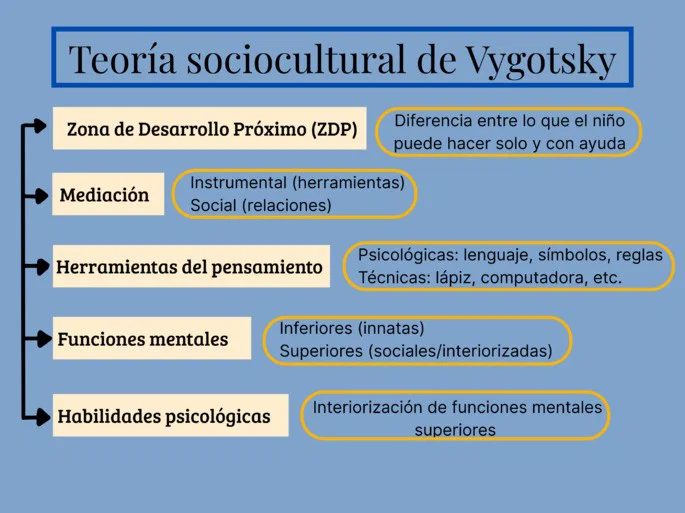
我们生来就有基本的生物工具。 心理学家将这些称为较低的心理功能 。 它们是原材料:简单的注意力、无意识的记忆、基本的感知。 你不学它们。 你继承了它们。
但这并不是人类智能的终点。
高级心理功能 是不同的。 他们是有学问的。 它们是通过社交互动获得的。 孩子不仅仅是在真空中“发展”逻辑推理。 他们通过与家长交谈、听取老师的意见以及了解社区规范来了解这一点。 大脑通过这些社交交流进行自我重组。
这个转变是关键。 我们从生物本能转向文化技能。
从社交到个人:心理技能
这是棘手的部分。 技能不仅仅出现在头脑中。 他们从外面开始。
维果茨基认为每个函数都出现两次。 首先,它出现在社会层面 (心理层面)。 然后,它出现在个人层面 (心理内部)。
想象一下一个幼儿正在学习调节自己的情绪。 起初,他们依靠父母来让他们平静下来。 家长充当监管者。 随着时间的推移,孩子会内化这个过程。 外部的帮助变成了内部技能。
社交变得个人化。 外在的指导变成了内在的声音。
What is the zone of proximal development?
This is the most famous part of Vygotsky’s work. This is also the most misunderstood point.
The Zone of Proximal Development (ZPD) is more than just a measure of what you are currently capable of. It’s the gap between what you can do alone and what you can do with help.
This is the distance:
1. Current development: Tasks that the child can solve independently.
2. Development potential: A task that the child can solve only under guidance or in cooperation with more competent peers.
If the student is unable to solve the math problem by himself, but is able to solve it under the teacher’s guidance, the problem is in the student’s ZPD. If a question is too difficult, it is out of scope, even if it is useful. If it’s too easy, they already know it.
ZPD is where learning happens. It’s a sweet spot of challenge and support.
塑造思想的工具
维果茨基并不认为心灵是一张白板。 他将其视为一个工具箱。 但这些工具不是您在商店购买的实物。 它们是社会发明。
他把这些分为两类:
- 心理工具: 这些是符号和系统。 语言是最重要的。 数字、地图、图表和助记符也是如此。 他们改变了我们的思维方式。 例如,写作可以让你在头脑中更长时间地保留复杂的想法。
- 技术工具: 这些是物理对象。 铅笔、电脑、锤子、剪刀。 它们改变了我们对待世界的方式。
这些工具调解我们与现实的关系。 你看到的不仅仅是一棵树。 你可以通过语言、生物学术语和文化价值的视角来看待它。 工具改变了想法。
The role of mediation
In Vygotsky’s theory, everything involves an intermediary. We do not directly interact with the world. We interact with it through tools and people.
Mediation takes place in two ways:
- Instrumental Mediation: Using (psychological or technical) tools to solve problems.
- Social mediation: Leverage relationships. teachers, parents, peers. These persons act as moderators and guide learners through the ZPD.
There is no advanced learning without intermediaries. It’s just a biological reaction.
この理論が心理学にとって重要な理由
ヴィゴツキーの作品は本棚にただ置かれているわけではありません。 それは私たちが心を研究する方法を変えます。 ベアトリス・カレラやクレメン・マッツァレラなどの研究者によると、発達心理学に対する彼の最大の貢献は具体的でした。
- 幼児期の社会的認知発達を理解する。
*言語とコミュニケーションがどのように進化したかを説明します。 - 私たちが読み書きをどのように学ぶのかを学びましょう。
ヴィゴツキー以前には、多くの心理学者は個人の脳だけに焦点を当てていました。 彼は彼らに脳を取り巻く文化を調べるよう強制した。
Vygotsky vs. Count: Two giants, different paths
We cannot talk about learning theory without mentioning Piaget. He and Vygotsky were often in a relationship. Both wanted to explain how people acquire information. We both knew things weren’t that simple.
However, there was disagreement about the engine problem.
The Count thinks the kid is a little scientist. Children interact with their physical environment. they are doing experiments. they failed. They build their own mental structures (schemas). Development promotes learning. Before learning, you need to prepare cognitively.
Vygotsky considered children as social subjects. Information is accumulated through interaction with others. Culture drives development. Learning leads to growth. Learn how to “create” new cognitive stages with ZPD.
Piaget focused on universal stages of biological maturation. Vygotsky focused on the specific cultural context that shaped his ideas.
Both are fine. Both are required. Piaget’s levels of developmental suitability and V are used in modern education.