You probably learned multiplication early on, but do you actually know what is happening under the hood?
It is not magic. It is just a faster way to add.
Take 2 x 3. That is not just two numbers sitting next to each other. It is a shortcut. It means you are adding the number 2, three separate times.
2 + 2 + 2 = 6
The result is 6. The process is simpler. You save time. You save mental energy.
This is the core of multiplication. It is a fundamental tool in arithmetic. It allows us to abbreviate repetitive sums. Instead of writing out long strings of additions, we use a single symbol.
But understanding the structure helps you master it.
The Parts of Multiplication
Every multiplication problem has three main components. If you know them, you can break down even the hardest problems.
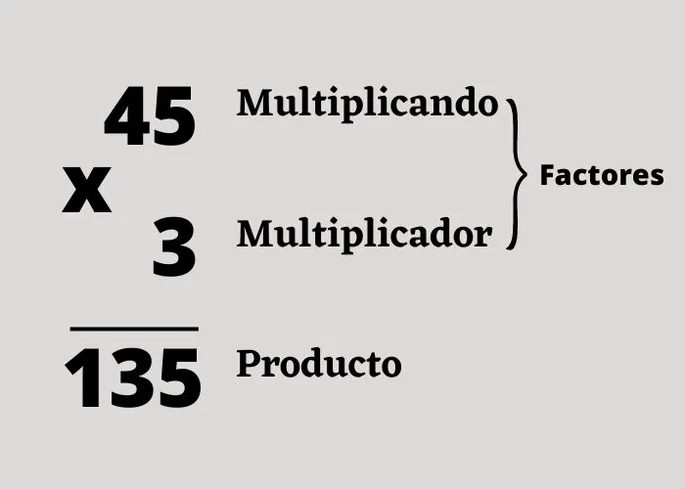
- The Multiplicand : This is the number being repeated. It is the “what”.
- The Multiplier : This tells you how many times to repeat the multiplicand. It is the “how many”.
- The Product : This is the final result.
Let’s look at a bigger example.
45 x 3
Here, 45 is the multiplicand. You are repeating it.
The 3 is the multiplier. You are doing it three times.
So, 45 x 3 is the same as 45 + 45 + 45.
Add those up.
45 + 45 = 90
90 + 45 = 135
The product is 135.
You could spend minutes adding. Or you could multiply. The answer is the same. The process is faster.
“Multiplication simplifies the process. Instead of performing three separate sums, you perform one single operation.”
Why does this distinction matter? Because as numbers get bigger, addition becomes impractical. Try adding 123 to itself fifty times by hand. You will make a mistake. You will get frustrated. You will never finish.
Multiplication prevents that. It scales.
Students often confuse which number is which. Does it matter?
Technically, in pure math, the order does not change the product. 2 x 3 is the same as 3 x 2. Both equal 6.
But in word problems, the order tells a story.
If you have 3 baskets with 2 apples each.
The multiplicand is 2 (the apples in each basket).
The multiplier is 3 (the number of baskets).
You are adding 2, three times.
Understanding this structure is the first step. Once you see multiplication as repeated addition, the abstract symbols start to make sense.
It is not about memorizing tables blindly. It is about seeing the pattern.
What happens when you add a zero?
What happens when you multiply by one?
These questions lead to deeper rules. But first, you need to be comfortable with the basics.
The foundation is solid. The logic is clear.
Now you just need to practice.
When you multiply, you are essentially doing repeated addition. It sounds basic, but understanding the anatomy of the operation helps prevent sloppy mistakes. Every multiplication problem has three distinct parts.
The multiplicand is the number being multiplied. It’s the base value. The multiplicador (multiplier) is the number that tells you how many times to add the multiplicand. Finally, there is the producto (product), which is the result you get when everything comes together.
Collectively, the multiplicand and multiplier are often just called factors. Knowing the difference matters when you’re explaining math to a child or debugging code, even if the math itself treats them interchangeably in the final result.
The multiplication symbol confusion
There is a persistent myth that the multiplication sign is an “x”. It isn’t. The traditional symbol is a decussata —a cross shaped like St. Andrew’s Cross (✕).
So why does everyone use “x”? Practicality. Most keyboards don’t have the ✕ symbol easily accessible. Typing “x” is faster. But here is the problem. In algebra, “x” is the standard variable for an unknown value. Seeing 5 x 3 is clear. Seeing 5 x x is a mess.
To avoid confusion, especially in algebraic expressions, use a dot (·) or an asterisk (*). These are cleaner. They signal multiplication without hijacking the variable slot.
Use a dot (·) or asterisk (*) in algebraic contexts to distinguish multiplication from variables.
How to multiply single digits
Start with the basics. Memorization is key here. You don’t need a calculator for 7 x 8. If you hesitate, you’re building a slow foundation for complex math.
Practice using flashcards or online drills. Aim for speed and accuracy. Once the single digits are automatic, move to larger numbers.
Multiplying larger numbers
Long multiplication is just repeated single-digit multiplication with place value management.
- Align the numbers. Put the larger number on top.
- Multiply digit by digit. Start from the rightmost digit of the bottom number.
- Carry over. If the result is two digits, keep the tens place and carry it to the next column.
- Shift left. When you move to the next digit in the bottom number, shift your result one place to the left. Add a zero as a placeholder if it helps you visualize.
- Add the partial products. Sum up all the intermediate results to get the final product.
Let’s say you’re calculating 123 x 45.
- Multiply 123 by 5. Result: 615.
- Multiply 123 by 4. Result: 492.
- Shift 492 one place left (4920).
- Add 615 + 4920 = 5535.
It’s mechanical. It’s tedious. It’s reliable.
Why this matters for students
Students often skip the “why” and just want the answer. But understanding factors vs. multiplicand helps when factoring polynomials later. It helps when understanding
Multiplicaciones largas: el arte del acarreo
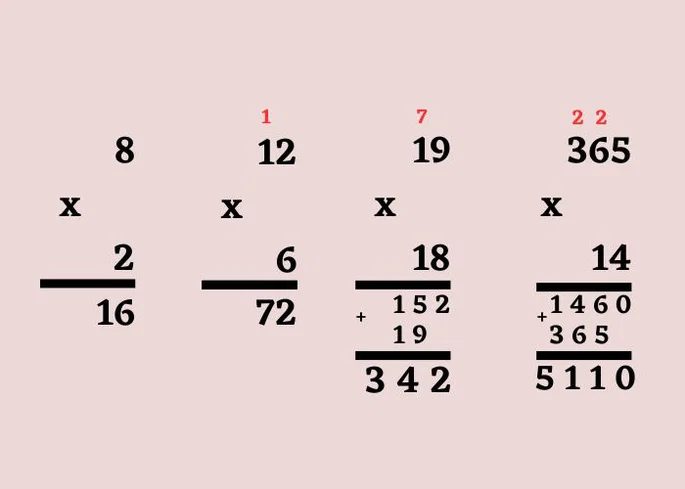
When you are dealing with multi-digit numbers, the horizontal format (like 12 x 6 = 72 ) quickly falls apart. That’s when you switch to the vertical method. It’s messy if you don’t align your columns. Units under units. Tens under tens. If those stacks aren’t straight, everything crumbles.
Here is how you actually do it. Start on the right. Multiply the units. Write the result below the line. But here is where it gets tricky. What if the result is bigger than nine?
Take 12 x 6. You start with 2 x 6. That equals 12. You can’t write 12 in the units column. You write down the 2. Then you take the 1 (the ten) and hold it. This is the carry-over or acarreo. You jot it small above the tens column. Don’t forget it.
Now you move to the next digit. Multiply the tens: 1 x 6. That gives you 6. But you don’t just write 6. You add the carry-over you held in your head. 6 + 1 = 7. Write that 7 in the tens column. Result: 72.
If the multiplier has more digits, you repeat this process. Multiply by the units digit. Write the result on a new line. Then multiply by the tens digit, shifting over one spot to the left. Do the hundreds. Finally, add all those partial products together. It’s arithmetic, not magic.
The hidden rules of multiplication
You can multiply integers, natural numbers, fractions, or complex numbers. The rules don’t change much. They just shift slightly based on the number type. Here are the properties that govern every single calculation.
The zero property (absorbing element)
Multiply anything by zero and you get zero. It’s a black hole.
1470 x 0 = 0
The identity property (neutral element)
Multiply any number by one, and it stays exactly the same. One is a mirror.
1470 x 1 = 1470
Closure property
Multiply two natural numbers? You get another natural number. No fractions. No decimals. Just whole numbers.
500 x 2 = 1000
Commutative property
Order doesn’t matter. 500 x 2 is the same as 2 x 500. The product remains 1000. You can swap the factors without breaking the equation.
Associative property
Grouping doesn’t matter either. If you have three numbers, it doesn’t matter which two you multiply first.
500 x 2 x 3 = 3000
500 x (2 x 3) = 3000
The result is identical.
Distributive property
This is the one teachers love to test. Multiplying a number by a sum is the same as multiplying the number by each part separately and then adding them up.
500 x (2 + 3) = 2500
Break it down:
(500 x 2) + (500 x 3)
1000 + 1500 = 2500
Same result. Different path.
How to handle signs
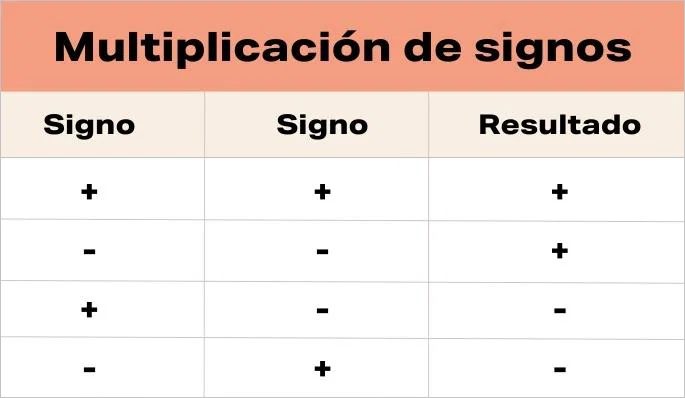
When negative numbers enter the chat, the game changes. How you multiply signs determines if your answer is positive or negative.
How sign rules actually work in multiplication
Most students memorize the sign rules as a rote list. It’s easier to see them as logical outcomes of how numbers relate to zero. When you multiply, you aren’t just combining quantities. You are also combining directions.
Think of a positive number as moving forward. A negative number as moving backward.
Positive times positive stays forward
This one is straightforward. You are moving forward, then moving forward again. The result is positive.
Take the example of 45 x 1.
You have forty-five units. You take one group of them. You still have forty-five. The sign remains positive because the direction didn’t change.
Negative times negative flips the direction
This is the part that trips people up. Why does a negative times a negative equal a positive?
Think of it this way: multiplying by a negative number reverses your direction. If you are already facing backward (negative) and you reverse that instruction again (another negative), you end up facing forward.
Look at -24 x -3.
You start with a deficit of twenty-four. The negative three tells you to reverse that deficit three times. Reversing a loss is a gain. The result is 72. It’s not magic. It’s consistency in direction.
Mixed signs flip the outcome
When signs differ, the result always loses its positivity.
If you multiply a positive by a negative, you are taking a forward step and then reversing it. The end result is backward (negative).
If you multiply a negative by a positive, you start backward and take forward steps. You stay backward.
See the symmetry here?
- 24 x -3 lands on -72.
- -24 x 3 also lands on -72.
The magnitude is the same. The direction depends entirely on whether you have one negative factor or two.
One negative factor? The answer is negative.
Two negative factors? The answer is positive.
It’s a simple filter. Count the negatives.
- Odd number of negatives? The product is negative.
- Even number of negatives? The product is positive.
Zero negatives? It’s positive.
This rule applies whether you are dealing with two numbers or twenty. You don’t need to calculate the whole thing first. You can just check the signs at the end to verify your work.
But why does this matter outside of homework?
Because real-world calculations often involve opposing forces. Debt against income. Deficit against surplus. Understanding how signs interact prevents errors in budgeting, physics, and data analysis.
Most people stop at the arithmetic. They forget that the sign is part of the value. Ignoring it is like ignoring the decimal point. The number looks right. The meaning is wrong.
Next time you see a negative sign in a multiplication problem, pause. Don’t just crunch the digits. Ask yourself: what direction am I going? Once you know that, the rest is just counting.