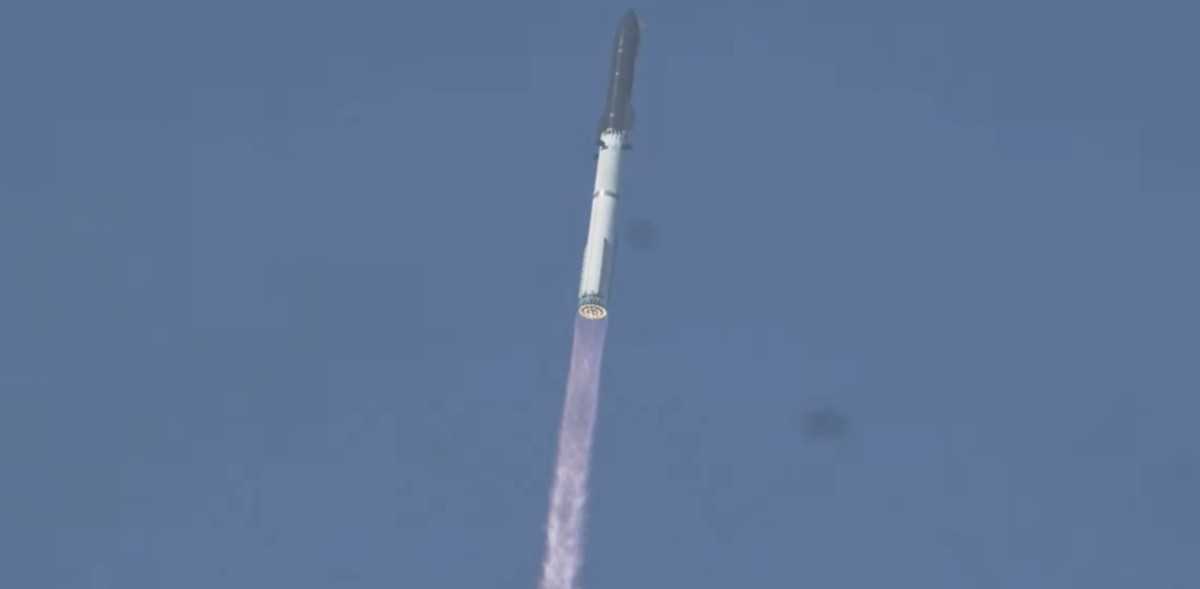
SpaceX did it again.
The second consecutive successful test flight of the Starship megarocket happened on Thursday, proving that the company is moving from chaotic experimentation to something resembling reliability. But don’t pop the champagne just yet. One part of the mission blew up, literally.
Here is exactly what happened during this pivotal test, why the booster failure matters less than you might think, and what this means for NASA’s moon plans.
The Launch and The Crash
Starship lifted off just after 6:50 p.m. Eastern time from Starbase in Boca Chica, Texas. It rode atop the Super Heavy V3 booster.
For two-and-a-half minutes, everything worked. The booster separated from the upper stage as planned. Then it turned toward the Gulf of Mexico for its return trip.
The goal? A pinpoint landing.
The reality? A fireball.
The booster’s landing burn failed. It hit the water and exploded spectacularly. So why call it a success?
The upper stage, the actual Starship, made it to orbit. That is the hard part.
While the booster failed to land, the payload stage executed its primary objectives. This distinction is critical for understanding Starship’s flight path to operational status. The booster is designed to be recovered, but right now, getting the ship to space is the priority.
Satellites, Cameras, and Engine Tests
Once in space, Starship wasn’t alone. It carried 20 Starlink V3 satellites.
These aren’t just random cargo. They are the same hardware SpaceX intends to use for its massive orbital internet constellation. For this test, they had a dual purpose:
- Some satellites had cameras.
- These cameras provided in-flight views of the heat shield to engineers on the ground.
Why check the heat shield? Because surviving re-entry is Starship’s biggest challenge.
After doing their job, the satellites tried to establish laser communications with the existing network. Then, they were abandoned to burn up in Earth’s atmosphere. They were test mules, not permanent residents of orbit.
Engine Improvements and Splashdown
This flight lasted an hour and five minutes. It was delayed from the previous week, but once it started, it flew the full course.
Starship showed distinct improvements over the May test flight. The Raptor engine issues from that earlier mission—where an engine shut down prematurely—were addressed. During this flight, the spacecraft successfully reignited one of its six engines for a brief burn while in space.
Alone now, Starship completed its journey by splashing down in the Indian Ocean north of Australia.
It caught fire briefly in the water.
It survived.
Why This Matters for Artemis
SpaceX wants Starship to replace the Falcon 9 as its main workhorse. With a cargo capacity of 100 tons to orbit, Starship can lift far more Starlink satellites per flight than the older rocket.
But the stakes go beyond broadband internet.
NASA is watching closely. The space agency hopes to use a lunar-lander variant of Starship for moon missions as part of the Artemis program. If SpaceX delivers on time, humans could walk on the moon for the first time in over 50 years as early as 2028.
There is competition for that slot. A watchdog report in March noted SpaceX is lagging. NASA is also funding Blue Origin to develop its own lunar lander as a backup.
This test suggests SpaceX is closing the gap. The booster crashed, yes. But the ship flew. The satellites launched. The engine reignited.
One part of the puzzle remains missing. The booster needs to land. Until then, the future of the moon stays slightly out of reach, hovering just above the Gulf of Mexico.