Syntax is the backbone of clear communication. It is the branch of grammar that dictates how words combine to form larger units of meaning. Without it, language collapses into chaos.
Think of syntax as the rulebook for order. It studies the relationship between words and the hierarchy they create. This hierarchy builds phrases (groups of words) and sentences (relationships between those phrases).
It also dictates word order. Consider the sentence “Pizza dinner Alberto wants.” It is nearly impossible to parse quickly. Why? Because it violates the standard Spanish word order. The correct structure is “Alberto wants to eat pizza.” The syntax ensures the message lands clearly.
But syntax is more than just word order. It covers how different types of sentences are constructed to maintain coherence. To truly grasp syntax, you need to break down its core components.
The Building Blocks of Syntax
Imagine syntax as a set of nesting boxes. Small units combine to make medium units. Medium units combine to make large units.
There are two primary steps in this process:
- Words group together to form syntactic phrases (sintagmas).
- Syntactic phrases relate to each other to form sentences.
What is a Syntagma?
A syntagma (or syntactic phrase) is a group of words centered around a nucleus.
Take the phrase “La silla de madera” (The wooden chair). The nucleus is silla (chair). The other words (la and de madera ) modify that nucleus.
The type of syntagma is determined by its nucleus word class.
| Syntagma Type | Abbreviation | Examples (Nucleus in bold ) |
|---|---|---|
| Nominal | SN | El perro grande, La barca azul |
| Verbal | SV | Llegó bien, Sigue estudiando |
| Adjectival | SAdj | Lo bonito, De joven |
| Adverbial | SAdv | Lo bien, Antes de todo |
| Prepositional | SP | Para todos, Hacia casa |
Note that a syntagma can sometimes be a single word. In “Carlos trabaja mucho” (Carlos works a lot), Carlos is a nominal syntagma consisting of just one word.
Syntactic Functions
A sentence is fundamentally a relationship between a Subject and a Predicate. Both are syntagmas. The subject is typically a nominal syntagma. The predicate is usually a verbal syntagma.
Syntactic functions define the role each syntagma plays within that relationship.
In the sentence “María bought a motorcycle” :
– María is the Subject.
– bought a motorcycle is the Predicate.
– Inside that predicate, a motorcycle functions as the Direct Object.
This follows the most common Spanish structure: Subject, Verb, Object.
Terms like Subject, Predicate, Direct Object, and Indirect Object are simply labels for the roles syntagmas play.
Context matters. Consider the nominal phrase los brazos (the arms).
– In “Juan exercises his arms”, it is a Direct Object.
– In “The arms are strong”, it is the Subject.
Here are the key syntactic functions in Spanish:
| Function | Example |
|---|---|
| Subject (Suj) | La policía arrested the thief |
| Verbal or Nominal Predicate | Juan is the best lawyer |
| Direct Object (CD/OD) | He called his friends |
| Indirect Object (CI/OI) | He gave a kiss to his boyfriend |
| Predicative Complement (CPred) | They finished exhausted |
| Circumstantial Complement (CC) | He will arrive home in the afternoon |
| Verbal Regime Complement (CRV) | He helped to get up |
| Agent Complement (CAg) | She was congratulated by her colleagues |
Types of Sentences
Every sentence contains at least one verb. The verb is the nucleus of the predicate and the most important element in the sentence.
Sentences are categorized by the number of verbs they contain: simple and compound.
- Simple sentences have a single verb or a verbal periphrasis (a multi-word verb form).
- Example: Lucas arrived at night.
- Example: Is going out with friends. (Here, is going out is a periphrasis).
- Compound sentences contain more than one verb or verbal periphrasis.
- Example: I go to the cinema and you go to the theater.
- Example: You don’t know what he told me yesterday!.
Compound sentences break down further into coordinated, juxtaposed, and subordinated types.
Syntax Analysis Examples
A syntax analysis involves identifying the components of a sentence and their specific functions.
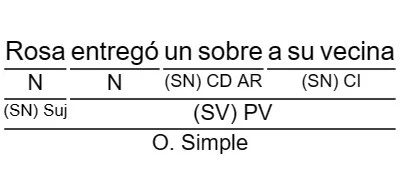
Let us look at a simple sentence: “Rosa delivered an envelope to her neighbor.”
We just broke down a simple sentence structure. It was straightforward. Rosa sat there as the Subject. The verb entregó did the heavy lifting as the Predicate’s core.
But language rarely stays simple.
Sometimes you need to nest ideas. You need to describe a noun using another clause. This is where syntax gets interesting. Consider this example:
Ese es el colegio en el que estudié.
This isn’t just a string of words. It is a complex structure. It contains a main clause and a subordinate clause. Specifically, a relative clause.
Breaking Down the Relative Clause
Let’s look closer at en el que estudié.
This is a subordinate relative clause (oración subordinada de relativo ). It modifies el colegio.
The whole sentence is composed. Why? Because it contains two verbs. Es and estudié. Each has its own subject and predicate structure, even if one is hidden.
The main clause is simple: Ese es el colegio.
But the part that follows? That’s where the grammar thickens.
The Role of the Relative Pronoun
The phrase en el que acts as the bridge.
- En is a preposition.
- El que is the relative pronoun.
Together, they link the action of studying to the location. Without them, you’d just have Ese es el colegio estudié. That breaks the syntax. It leaves the verb hanging.
In linguistic terms, en el que functions as a complement within the subordinate clause. It allows the clause to stand in for a prepositional phrase.
Why This Matters for Learners
Students often struggle with relative clauses. They see que and el que and get confused.
Here is the rule:
- Identify the antecedent. (El colegio ).
- Identify the relationship. (Location).
- Choose the correct preposition + pronoun. (En + el que).
If you were talking about people, you might use a quien. If it were the object, just que. But for location? You need the preposition.
This isn’t just about passing a test. It’s about clarity.
When you write or speak, nested clauses allow you to pack information efficiently. You don’t need three sentences. You can do it in one.
Ese es el colegio en el que estudié.
One sentence. Three verbs implied or stated. One main idea.
Mastering this structure separates basic speakers from fluent ones. It’s not about memorizing rules. It’s about seeing the architecture.
The skeleton remains the same. Subject, Verb, Object. But sometimes, the object wears a mask. Sometimes, it holds a whole other sentence inside it.
Keep looking for those layers. They are everywhere.
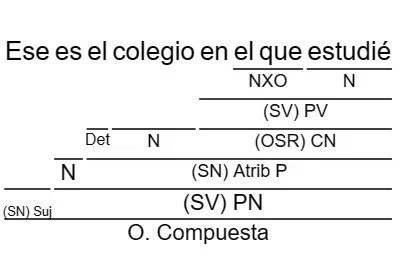
Breaking Down the Grammar of “That”
Let’s cut through the jargon. We aren’t here to write a linguistics thesis. We are here to understand how a simple sentence works.
Take this specific structure. It seems straightforward until you look under the hood.
Subject: “Ese”
At the core is a Noun Phrase (Sintagma Nominal ). The headword is Ese. It holds the position of the Subject (Suj ). It points. It anchors the sentence.
The Predicate: “is the school…”
Then comes the Verbal Phrase (Sintagma Verbal ). The whole chunk reads: es el colegio en el que estudié. Its job is to serve as a Nominal Predicate (Predicado Nominal ). The engine here is the verb es.
But wait. There is more inside that phrase.
The Attribute and the Relative Clause
Inside the verbal phrase sits another Noun Phrase: el colegio en el que estudié. It functions as an Attribute (Atrib ). The headword is colegio.
And nested within that? Another Verbal Phrase. en el que estudié. This is a Relative Subordinate Clause. It describes the school. It tells us which school.
Look at the internal mechanics of that clause.
- Nexo (Connector): el que acts as the link. It bridges the noun to the action.
- Núcleo (Head): estudié is the core action. The verb. The thing that actually happened.
Why This Structure Matters for Learners
You might think this is just about Spanish grammar rules. It isn’t. It’s about clarity.
When you learn to identify these parts, you stop guessing. You start seeing the skeleton of the language.
For students:
It helps with sentence construction. Instead of writing a rambling sentence, you know where the subject ends and the predicate begins. You know where the relative clause attaches.
For parents:
It helps in explaining homework. When your child asks why en el que is together, you can point to the structure. It’s not magic. It’s syntax.
For lifelong learners:
It improves reading comprehension. You parse faster. You understand complex texts without getting lost in the clauses.
The Practical Takeaway
Don’t overthink the labels. Focus on the function.
- Identify the subject (Ese ).
- Find the main verb (es ).
- Locate the attribute (colegio ).
- Spot the relative clause (en el que estudié ).
Once you see the pattern, it becomes intuitive. The grammar stops being a set of rules and starts being a tool. A tool for thinking clearly.
Try it with another sentence. Break it down. See what holds it together. The logic is always there. You just have to look for it.