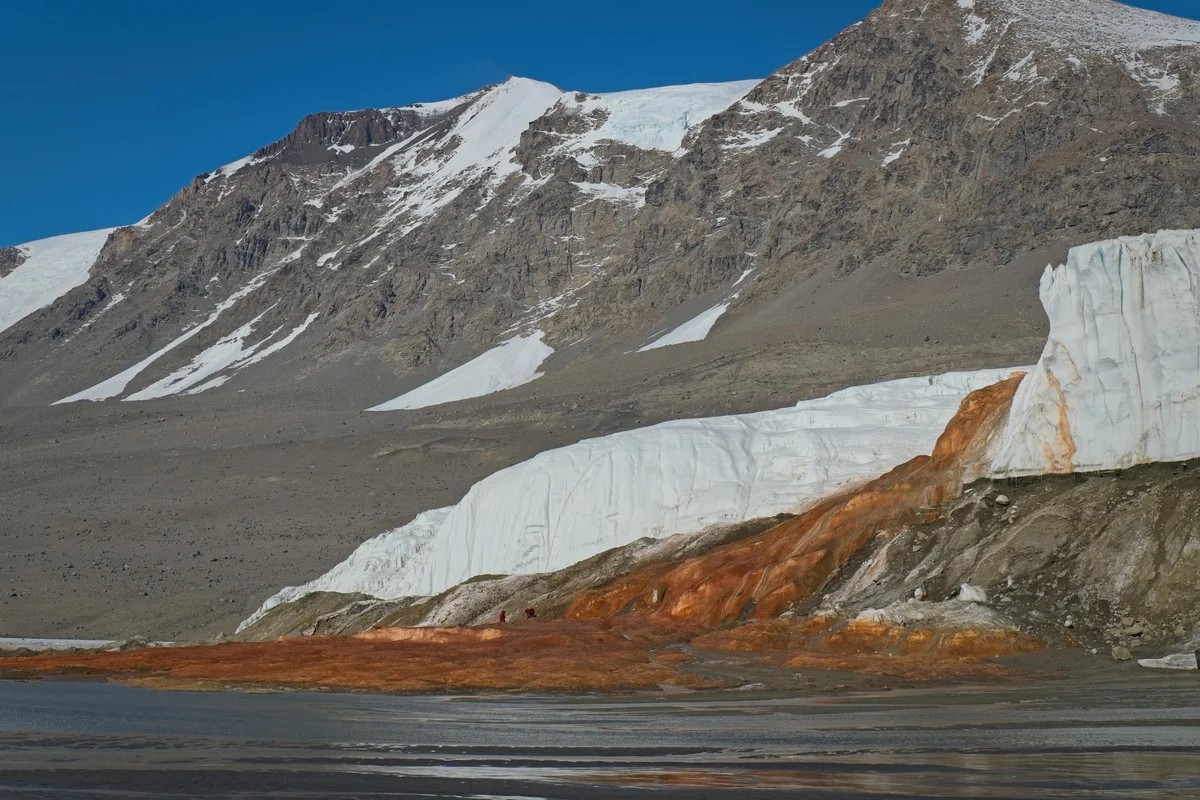
It looks like a wound in the ice. A thick, rust-red plume cascades down the Taylor Glacier, staining the snow and seawater a deep crimson. The name is literal: Blood Falls.
But don’t expect a geyser of volcanic blood. This is iron-rich brine leaking from a frozen underground lake, oxidizing as it hits the air. For a long time, scientists assumed this hypersaline, toxic environment was dead. Sterile. Abiotic.
Andrew Allen, a marine biologist at Scripps Institution of Oceanography, visited the site. He noticed the stillness. “The whole landscape is just a level of pristine,” he says. No vertebrates. No plants. Just ice. It feels dead until you look closer.
Then you find life.
Finding Eukaryotes Where None Should Exist
In a new study published in Nature Geoscience, Allen and his team report a surprising discovery: eukaryotic species in Blood Falls.
Eukaryotes have complex cells with organelles. They aren’t just bacteria. They are the building blocks of plants, animals, and fungi. Finding them in such a harsh, isolated environment changes the narrative.
The microbes were not found in the subglacial lake itself—the source of the red color. Instead, they were in the flowing brine.
This raises a massive geological question. These organisms are related to marine species. They are cousins to ocean life. But the nearest open ocean is over 20 miles away, blocked by miles of glacial ice. How did they get there?
The Two Million-Year Isolation
The leading theory isn’t wind. It’s time.
Around two million years ago, during the Pleistocene epoch, seawater was trapped beneath the ice sheet as the glacier advanced. The water levels dropped. The ocean receded. The lake was sealed off.
“We think that this periodic outflow of brines creates a habitat where marine microbes could persist,” Allen explains.
But the origin story is more specific. Wind dispersal is unlikely. The microbes are too complex. They were likely left behind. They were trapped in the ancient seawater that got buried under the ice.
Think about that. These microbes have survived in total isolation since Homo erectus was first emerging from the shadows of evolution.
They are relics of a drowned world, preserved in a frozen tomb, now slowly weeping out onto the surface.
These lineages obviously have a lot of iron surrounding them.
Iron Paradox
There is one detail that still bugs Allen.
The specific eukaryotic lineages found at Blood Falls usually thrive in waters that are poor in iron. They prefer nutrient-light, oligotrophic environments.
Blood Falls is the opposite. It is saturated with iron. The brine is incredibly dense with it. The red color is essentially iron oxide—the same stuff as rust on an old car.
Why are these iron-sensitive organisms thriving here?
“We’d be interested to know more about what [they’re] doing with iron,” Allen says.
They aren’t just surviving. They are adapting. Or perhaps, they are waiting.
Why This Matters
Studying Blood Falls isn’t just about categorizing weird microbes. It’s a window into extremophiles. It shows how life can hang on when the surface world changes.
When climates shift. When glaciers move. When the oceans recede.
Life doesn’t just disappear. It hides. It buries itself. It waits in the dark, salt-filled spaces, holding onto the past.
We know these organisms are related to ocean life. We know they are ancient. We don’t yet know exactly how they process the iron that should kill them. But we know they are there.
The ice is cracking. The red water is flowing. And millions of years of isolation are finally breathing the air.
What else is waiting down there, in the dark?