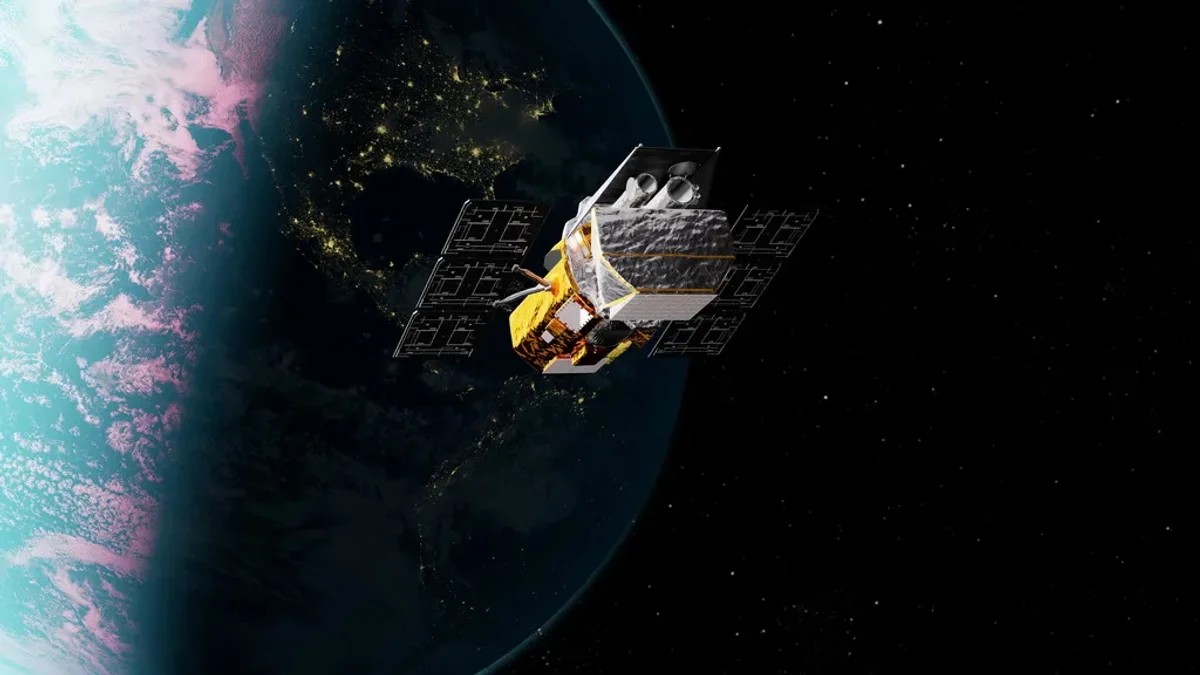
A rescue mission for a aging NASA space telescope has hit a massive snag.
The spacecraft sent to save it is now in trouble itself.
This isn’t supposed to happen. The plan was simple. The Lightweight In-Space Navigation and Kinometrics (LINK) servicing craft would grab NASA’s Neil Gehrels Swift Observatory, boost its orbit, and give it years of new life. Instead, LINK has started spinning. It lost contact. Two of its three reaction wheels are dead. One set of thrusters is failing.
Now, the rescuer needs rescuing.
How the Swift observatory rescue failed
LINK was built in record time. Katalyst Space Technologies, an Arizona startup, took the contract in January and launched the $30 million craft in early July. That’s nine months.
They did it because Swift was dying.
Solar activity spiked. The sun’s heat pushed Swift’s atmosphere out, creating drag. The 350-kilometer orbit decayed faster than expected. NASA paused observations last month. Without intervention, Swift would burn up in the atmosphere sometime this year. It is one of the most productive telescopes ever built. It detects gamma-ray bursts and swivels its ultraviolet, optical, and X-ray sensors to catch cosmic explosions as they fade.
LINK was supposed to fix that.
It carried three robotic arms. The idea was to rendezvous, grab the observatory, and use xenon-gas thrusters to push it higher. But before it could get anywhere near Swift, things broke.
Why reaction wheel failures matter
The trouble started over the weekend. LINK had already passed major milestones. Solar arrays were up. Thrusters were fired during commissioning. Then, it went sideways. Literally.
NASA says LINK began spinning out of control. Communications went dark temporarily.
Reaction wheels are how a spacecraft stabilizes its orientation. Think of them as gyroscopes. If they stop working, you can’t steer. You can’t hold your position. You spin.
Two of the three wheels are out. The third one is struggling. The small thrusters meant for fine guidance have lost functionality.
“The mission remains active… We continue to believe that with these changes, LINE has a viable path to rendezvous with [Swift].”
— Katalyst Space Technologies
This isn’t just about one telescope. LINK is a prototype. It tests if robots can service satellites that were never designed to be repaired in space. Before, you needed astronauts. The space shuttles took crews out five times to fix Hubble. Hands-on work. Risk. Human intuition when things went wrong.
Robots alone are the test. If LINK fails, does the future of orbital servicing die too?
Can Katalyst stabilize LINK in orbit?
The company is trying to fix the spin using the remaining xenon thrusters. Initial maneuvers are working, according to Katalyst. But don’t expect a quick fix. Stabilization will take several days.
Even if LINK stops spinning, it’s not home free.
The company plans to rewrite software to work around the dead hardware. Only then can they assess if the craft is healthy enough to approach Swift. Swift was not designed to be caught by another ship. It’s a fragile target in a hostile environment.
Any capture attempt is now weeks away, minimum.
This delay matters. Swift’s utility is about to increase. New survey observatories are launching. The Vera C. Rubin Observatory in Chile is coming online. NASA’s Nancy Grace Roman Space Telescope is on the horizon. They will find transient phenomena. Swift is needed to swivel quickly and catch the light.
If LINK can’t save Swift, we lose a key tool for astrophysics. If LINK fails entirely, we lose faith in robotic servicing.
Katalyst says there is a viable path. But in orbit, viability is a thin line between survival and debris. The wheels are quiet. The thrusters are firing blindly into the void. We’ll see if it holds.