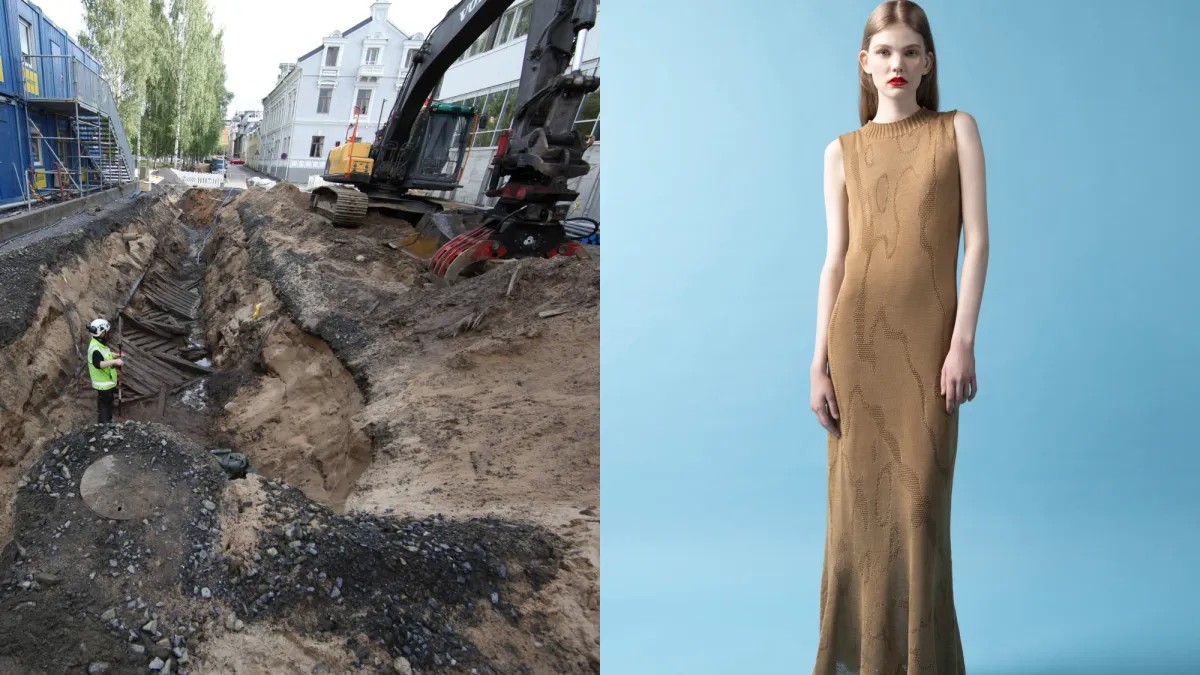
Most people think pirates and gold. Not haute couture.
When a sunken ship surfaces, it usually goes straight to a museum display case. Studied. Preserved. Forgotten. Not so here. In Finland, scientists took wood from a 1600s shipwreck, turned it into fabric, and knit it into a dress. Actually wore it. This is the Shipwreck Dress, a two-year collision between maritime archaeology, chemistry, and high fashion.
It’s not just a gimmick.
“Underwater cultural heritage is ofteninvisible,” said Minna Koivikko from the Finnish Heritage Agency. “It’s almost like spokesperson for history—with a modern twist,” she said, calling the garment a way to drag dead history into our daily lives.
The Hahtiperä Wreck
The source material? A cargo ship named Hahtiperä, found off Oulu in 2017. The timber is dated to 1684. Grown in the Ostrobothnia forests of southwest Finland, then nailed together, then sunk, then recovered.
Here’s the problem: some of that wood was headed for the trash bin. Conservation work leaves fragments that don’t fit into displays. They were documented, yes, but useless. Wasted. Koivikko didn’t like that. She started wondering if those fragments had a second act.
She grabbed chemists. She grabbed designers. She grabbed forestry experts. The goal? Make the dead wood work again.
From Waterlogged Rot to Silk-Like Fiber
The tech hero is bioengineer Inge Schlapp-Hacks. She didn’t just sand it down. She stripped the outer layers to expose the core of the 300+ year-old wood. Then shredded it. Then dissolved it into pulp.
Using the patented Ioncell® process, they treated that pulp with ionic liquids—solvents that turn cellulose into fibers without toxic chemicals. No cotton. No polyester. Just ancient tree cells, rearranged.
“Ioncell® fibres have silky feel,” Schlapp-Hacks explained. Stronger than cotton, too. And look at that brown hue? Undyed. Unbleached. The color comes from the wreck itself.
The yarn they spun was surprisingly sturdy. They used a computer program to design patterns, saving energy, then knitted the dresses using Shima Seiki machines. One piece. Seamless. Three-dimensional. Zero fabric waste. Because why waste anything when you’re trying to save a planet?
A Lesson in Waste
Pirjo Kääriäinen of Aalto University has spent fifteen years researching this. She’s been waiting for materials that make sense. This dress? It’s a statement on consumption.
“A shipwreck is an exceptionalcase,” Kääriäinen admitted. “But it makes people pause.”
If centuries-old rotting wood can become beautiful clothing, what’s our excuse for tossing out modern scraps?
The dress lands at the Oulu Museum of Art on May 22. A twin piece waits at Aalto University’s Designs for Cooler Planet show this September.
Maybe next time you see old timber, you’ll think of silk.