A rectangle is a specific type of flat geometric shape. It belongs to the family of quadrilaterals and parallelograms. This closed figure has two pairs of opposite sides that are equal in length. It also features four right angles.
The dimensions of a rectangle can vary. They never have all four sides equal. That would make it a square. The key feature is that one pair of sides is longer than the other pair. This creates an elongated shape. It stretches in one direction. It can be horizontal or vertical.
A rectangle is defined by its right angles and unequal opposite sides.
Students often confuse squares and rectangles. A square is a rectangle with equal sides. A true rectangle has distinct length and width. This distinction matters in geometry class. It also helps in real-world applications. Think of a door. Think of a book. These are rectangles.
Why does this matter? Knowing the properties of a rectangle helps you calculate area and perimeter. You need the length of both pairs of sides. One pair is longer. The other is shorter. Multiply length by width for area. Add all sides for perimeter. It is straightforward math.
Visualizing the shape is the first step. Imagine a frame. It has four corners. Each corner is 90 degrees. Opposite sides run parallel. They never meet. This structure is stable. It is used in construction. It is used in design.
Lifelong learners should remember this basic definition. It is the foundation for more complex shapes. Circles come later. Triangles are next. But rectangles are everywhere. Start with the basics. Master the simple rules. Then move on.
The elongated shape allows for efficient use of space. It fits on walls. It fits on floors. It fits on screens. The orientation does not change its properties. A landscape rectangle is still a rectangle. A portrait rectangle is the same shape. Just rotated.
Keep it simple. Two pairs of equal sides. Four right angles. One pair longer than the other. That is all you need to know for now.
You are looking at a shape. It has four sides. It has four corners.
It belongs to the quadrilateral family. But it is not just any four-sided figure. It stands apart from trapezoids, rhombuses, and rhomboids for one specific reason. All its angles are right angles. That is 90 degrees. Every single one.
It also differs from the square. A square demands that all sides be equal length. A rectangle does not. The sides can be different. They often are.
Think about the room you are in. The monitor in front of you. The smartphone in your pocket. The book on your desk. The bed you sleep in. The bill in your hand. These are all real-world examples of rectangular figures.
Key Characteristics of the Rectangle
Let’s break down what makes a rectangle a rectangle. It is a special type of parallelogram.
First, it is a quadrilateral. It has four sides and four vertices. Simple enough.
Second, it is a parallelogram. This means opposite sides are parallel to each other. They run in the same direction and never meet.
Because of this structure, opposite sides in a rectangle are equal in dimension. Adjacent sides are perpendicular. They meet at a perfect right angle. This geometry forces every internal angle to measure exactly 90º.
The rectangle has two axes of axial symmetry. If you slice it horizontally through the center, you get two equal parts. If you slice it vertically, you get two equal parts. Each half is a rectangle or a square. Both halves have the same area.
Orientation does not change the shape. A rectangle can be horizontal or vertical. The sides can be any length greater than zero. But if all sides become equal, the shape transforms into a square. It stops being a rectangle and becomes something more specific.
There is a common misconception about proportionality. The two pairs of sides are not directly proportional. If you increase the length of the base, the height does not need to change. They are independent variables. However, the diagonals are proportional to the lengths of the sides. The relationship holds mathematically, even if the sides themselves are not linked by a fixed ratio.
You can inscribe a rectangle in a circle. The circle touches all four vertices. In this case, the diameter of the circle is exactly equal to the length of the rectangle’s diagonals.
Cut the rectangle along one diagonal. You create two right-angled triangles. These triangles are identical in dimension. Cut it along both diagonals. You get four isosceles triangles. The geometry is precise. It is predictable.
Parts of the Rectangle
Every rectangle is composed of specific elements. Understanding these parts is essential for calculating area, perimeter, and diagonals.
The main components include:
- Sides: The four line segments that form the boundary. There are two pairs of equal length sides.
- Vertices: The four points where the sides meet. Each forms a 90-degree angle.
- Diagonals: The two lines connecting opposite vertices. They are equal in length and bisect each other.
- Angles: The four internal angles, each measuring 90 degrees.
Why does this matter? Because these parts define the shape’s behavior. You cannot have a rectangle without right angles. You cannot have a rectangle without parallel opposite sides. It is a rigid structure.
Consider the diagonal again. It is the longest line segment inside the shape. It creates the bridge between opposite corners. It is also the diameter of the circumcircle. This link between linear distance and circular geometry is not accidental
The hidden geometry of everyday shapes
Most people glance at a rectangle and see a shape. They don’t see the math holding it together. But understanding these components isn’t about memorizing definitions for a test. It’s about seeing how space works.
Let’s break down what actually makes up a rectangle.
The basic building blocks
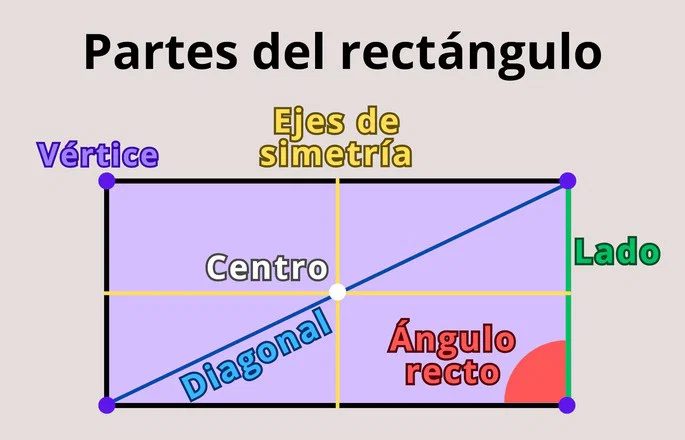
Start with the Lado. This is Spanish for side. Each rectangle has four straight lines. They connect adjacent vertices. The longest side is usually the base. The shorter ones? Those are the height. It’s a practical distinction.
Then there are the Vértice. Four points. That’s it. Each vertex connects two adjacent lines. If the lines are the walls, these are the corners.
Inside those corners? Ángulo recto. All four angles are ninety degrees. Or π/2 radians if you want to be precise. They are right angles. Always.
At the very middle sits the Centro. It’s equidistant from opposite sides. It’s where the diagonals cross. It’s also on the axes of symmetry. It’s the anchor point.
Speaking of diagonals, the Diagonal is one of two lines. It connects opposite vertices. It passes straight through the center. It’s the shortest path between two far corners.
And finally, Ejes de simetría. Vertical and horizontal lines. Draw them, and you split the rectangle into two identical halves.
Why the dimensions matter
Knowing the parts is one thing. Calculating their impact is another. This is where the properties of the rectangle come into play.
Perimeter. Area. Diagonal.
These aren’t just abstract concepts. They determine how much material you need. How much space you have. How far a shadow stretches.
Calculating perimeter accurately
The perimeter is simple in theory. Sum all sides. But since a rectangle has two pairs of equal-length sides, you can shortcut the math.
Use this formula:
Perimeter = 2 x Base + 2 x Height
Let’s look at real numbers. Suppose you have a rectangle.
Base: 40 cm.
Height: 20 cm.
Plug them in.
2 x 40 = 80
2 x 20 = 40
80 + 40 = 120 cm.
The perimeter is 120 centimeters. Not 100. Not 125. Exactly 120. Getting this wrong means buying too much trim. Or not enough.
Finding the exact area
Area is different. It’s not the edge. It’s the space inside.
Formula:
Area = Base x Height
Using the same example:
40 cm x 20 cm = 800 cm².
Eight hundred square centimeters.
If you’re tiling a floor, this number tells you how many tiles to buy. If you’re painting a wall, it tells you how much paint. Precision matters here. A small error in measurement compounds quickly over large areas.
Using the Pythagorean theorem for diagonals
This is where it gets interesting.
You can’t just add the base and height to get the diagonal. It’s not linear. You need the Teorema de Pitágoras.
The formula:
Diagonal = √(Base² + Height²)
It treats the base and height as the legs of a right triangle. The diagonal is the hypotenuse.
Back to our 40×20 rectangle.
40² = 1600
20² = 400
1600 + 400 = 2000
√2000 ≈ 44.72 cm.
Both diagonals are identical. 44.72 centimeters each.
Why does this matter? If you’re hanging a picture frame, checking if it’s square involves measuring both diagonals. If they match, your corners are true. If they don’t, your frame is skewed.
It’s not just math. It’s structural integrity.