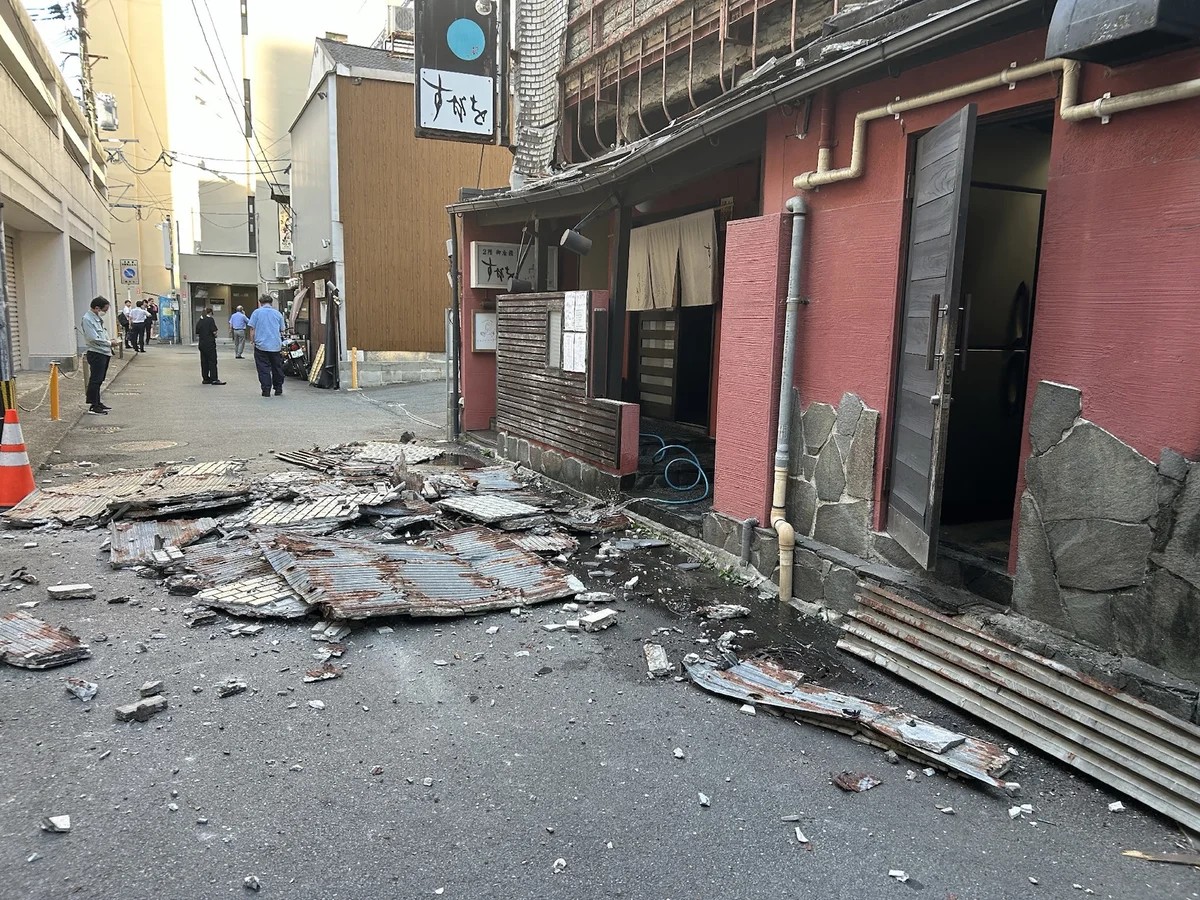
A magnitude 6.8 tremor tore through Kyushu on Tuesday. The epicenter sat just south of Kumamoto. It wasn’t just a shake. It was a destruction event. Fires ignited. Roads buckled. Buildings crumbled, including a mall where rescuers are currently digging through rubble to find trapped people.
What caused this specific devastation? It wasn’t the typical mega-thrust. This was a strike-slip quake. The crust fractured. The sides slid past each other with violent intent.
But why here? Why so much damage for a 6.8?
Kyushu: A tectonic nightmare
Kyushu isn’t just a random island. It is a geological intersection. Independent scientist Amilcar Carrera-Cevallops describes it as “one of the most seismically complex spot in Japan.”
Think of it as a tectonic crossroads. The forces at play are contradictory, pulling the land in opposing directions.
On one side, the Philippine Sea Plate dives under the Eurasian Plate. It’s subducting. Moving at about 40 to 50mm per year. That’s roughly two inches of grinding pressure annually.
On the other side? Extension.
A back-arc basin is pulling the land apart. This stretching creates the Beppu-Shimabata graben. It’s a rift zone. Riddled with active faults. Volcanoes like Aso and Unzen sit atop this instability.
You have subduction pushing from one flank. Rifting pulling from the other. Then you cut that entire mess with a major strike-slip fault: the Median Tectonic Line.
The 6.8 happened along a local fracture within the Eurasian Plate itself. Not the main trench. Just a local hairline crack in the crust.
The danger of shallowness
Depth matters more than magnitude.
This quake occurred only about 10 kilometers below the surface. Six miles. That’s shallow.
“That shallowness is a big part of why the shaking reached the highest level on Japan’s scale.”
The USGS scale goes up to Shindo 7. This quake hit 7. Directly underneath a population center.
Geophysicist Allen Husker notes the placement was critical. If this energy had been released closer to the subduction trench—deeper, further from cities—the impact would have been significantly lower. Here? It hit home. Literally.
The shallow depth explains the collapsed buildings. The collapsed bridges. The intensity didn’t dissipate before reaching the surface.
Comparing to 2016: The Kumamoto foreshocks
This isn’t the first time Kumamoto has suffered.
In 2016, a spate of deadly tremors hit the region. Also strike-slip. Also struck some of the same towns. But the sequence was different.
The 2016 disaster started with a 6.2. Then, roughly 36 hours later, a 7.0 hit on a different fault. Nobody saw that second monster coming.
The 6.8 today followed no foreshock of that nature. It was a singular, high-magnitude event. But Carrera-Cevallos points out the similarity in the fault mechanics.
“The big difference is what happens next.”
We don’t know what happens next. Earthquake sequences are notoriously unpredictable. One day of calm does not mean safety.
Why local faults are engineering’s worst nightmare
This event exposes a flaw in how we build.
We design for subduction quakes. Big, deep, distant. We account for the long waves.
Local faults don’t care about our models.
Carrera-Cevallops highlights a critical problem in structural engineering. Local faults are numerous. They are poorly mapped compared to the major subduction interfaces. Yet they produce intense peak ground accelerations.
Close to the source.
These are high-frequency shakes. The kind that rattles teeth and shatters unreinforced structures. The older buildings in Kumamoto fell victim to this specific frequency.
It’s a difficult problem to solve. How do you map every small crack in the earth? You can’t. You have to assume the worst.
“This is a seismically mature region, but events like this remind us of details we still don’t fully understand.”
Even with advanced monitoring, tectonic settings can surprise us. The Median Tectonic Line is well-known. The graben is mapped. But the interactions? The exact moment a fracture releases 10 kilometers down?
That remains unpredictable.
The fires are still burning in parts of Kumamoto. The rescue efforts continue. The ground there is tired. But the plates are still moving. Pushing. Pulling. Sliding.
Waiting for the next release.