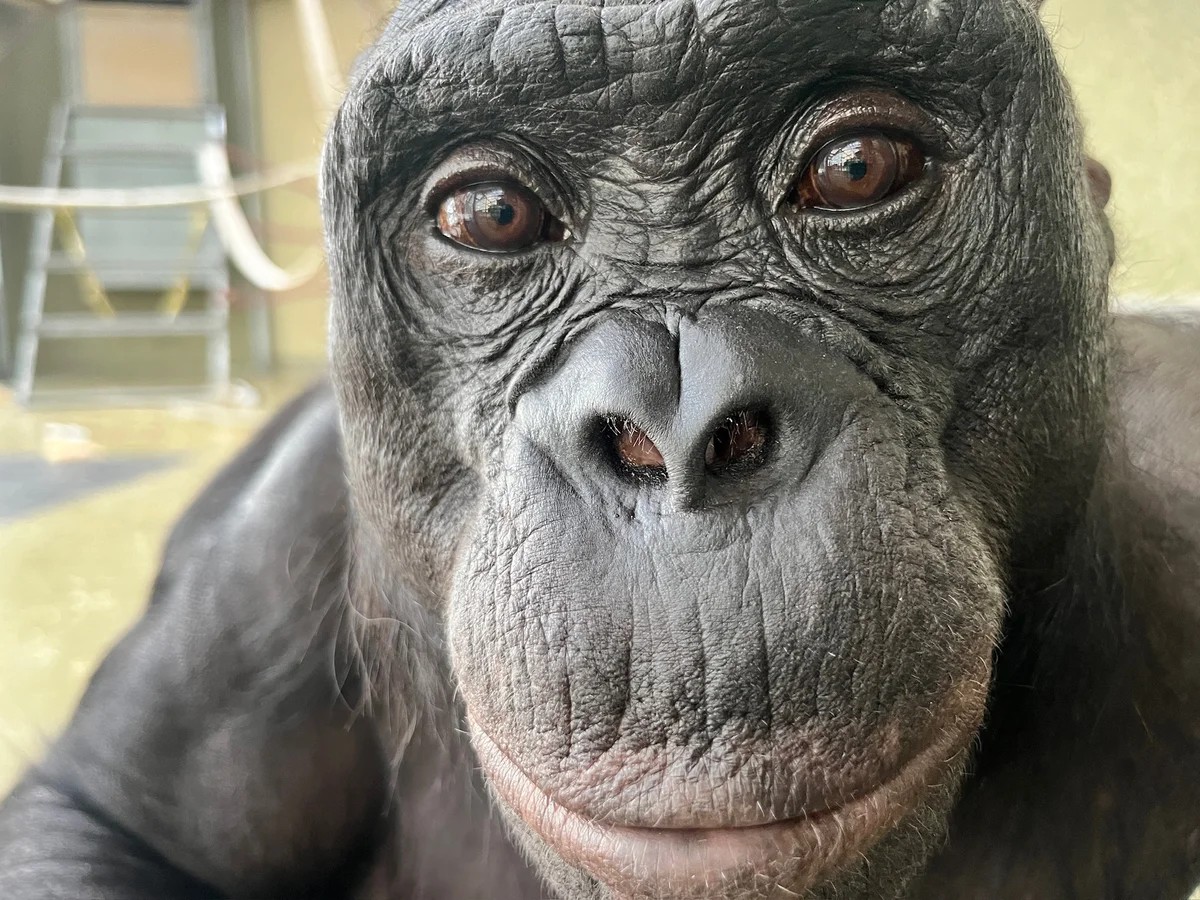
A new study published in Science provides compelling evidence that Kanzi, a deceased bonobo renowned for his advanced communication skills, grasped the concept of pretense – the ability to understand and participate in imaginary scenarios. The findings suggest that the capacity for abstract thought and imagination may not be exclusive to humans, raising questions about animal cognition and the nature of consciousness.
Kanzi’s Breakthrough: Testing Pretend with Juice and Grapes
The research, led by Amalia Bastos, built upon classic developmental psychology experiments used with human children. Researchers presented Kanzi with transparent cups, an empty jug, and fruit juice. They then pretended to pour juice into the cups, “pouring out” one of them before asking the bonobo where the juice was.
Kanzi consistently pointed to the cup that still appeared to contain juice, demonstrating an understanding that the action was not real. The experiment was replicated with pretend “grapes,” yielding similar results. When offered a choice between real and fake juice, Kanzi predictably favored the genuine beverage – though this doesn’t negate his understanding of the pretend scenario.
Why This Matters: Beyond Human Exceptionalism
For decades, cognitive science has largely centered on human intellect as the benchmark. This study challenges that assumption. Kanzi’s ability to engage with pretense suggests that the mental processes supporting imagination may be more widespread in the animal kingdom than previously believed.
This has broader implications : if bonobos can understand pretense, it raises questions about the cognitive abilities of other species, particularly those with complex social structures. Why did this ability evolve in bonobos? Is it linked to their social interactions, problem-solving, or something else entirely?
Skepticism and Future Research
Not all scientists are convinced. Daniel Povinelli, a biology professor, argues that Kanzi may have simply followed human cues without necessarily grasping the underlying concept of pretense. He suggests the bonobo may have been responding to the experimenters’ actions rather than the imaginary scenario itself.
Despite this skepticism, the findings support anecdotal evidence of similar behavior in other apes. Female chimpanzees have been observed carrying sticks as if they were infants, and captive chimps have mimicked playing with invisible objects. The research underscores the need for further investigation into animal cognition, particularly now that Kanzi – the subject of this study – is no longer alive to participate.
The study’s authors hope these results will inspire greater conservation efforts for bonobos, an endangered species, and fuel broader research into animal imagination. The capacity to distinguish between reality and pretense may be just one piece of a larger puzzle surrounding animal intelligence.